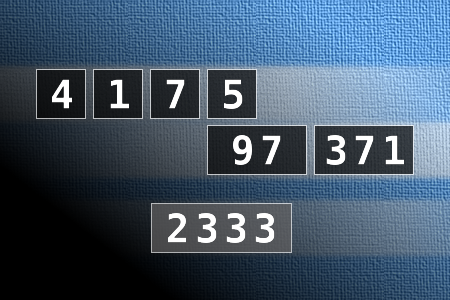
Calculate the number 2333
[5955] Calculate the number 2333 - NUMBERMANIA: Calculate the number 2333 using numbers [4, 1, 7, 5, 97, 371] and basic arithmetic operations (+, -, *, /). Each of the numbers can be used only once. - #brainteasers #math #numbermania - Correct Answers: 13 - The first user who solved this task is Nílton Corrêa De Sousa
BRAIN TEASERS
enter your answer and press button OK

Calculate the number 2333

NUMBERMANIA: Calculate the number 2333 using numbers [4, 1, 7, 5, 97, 371] and basic arithmetic operations (+, -, *, /). Each of the numbers can be used only once.
Correct answers: 13
The first user who solved this task is Nílton Corrêa De Sousa.
#brainteasers #math #numbermania
Register with your Google Account and start collecting points.
Check your ranking on list.

Grandma's Revenge

When my three-year-old son opened the birthday gift from his grandmother, he discovered a water pistol. He squealed with delight and headed for the nearest sink. I was not so pleased. I turned to Mom and said, "I'm surprised at you. Don't you remember how we used to drive you crazy with water guns?"
Mom smiled and then replied....."I remember."      

Jokes of the day - Daily updated jokes. New jokes every day.
Follow Brain Teasers on social networks

Brain Teasers

puzzles, riddles, mathematical problems, mastermind, cinemania...

Herbert Spencer

Died 8 Dec 1903 at age 83 (born 27 Apr 1820). English sociologist and philosopher who was an early adherent of evolutionary theory. He regarded society as an organism which was evolving from a simple primitive state to a complex heterogeneous form according to the designs of an unknown and unknowable absolute force. Similarly, knowledge developed from an undifferentiated mass into the various separate sciences. Formulating his ideas independently of Darwin, Spencer coined the phrase “survival of the fittest” as early as 1852. He applied Darwin's theory of natural selection (proposed four years later) to social development and in A System of Synthetic Philosophy (1862-96) presented a philosophical system to the natural and social sciences, synthesizing metaphysics, biology, psychology, sociology, and ethics.
This site uses cookies to store information on your computer. Some are essential to help the site properly. Others give us insight into how the site is used and help us to optimize the user experience. See our privacy policy.