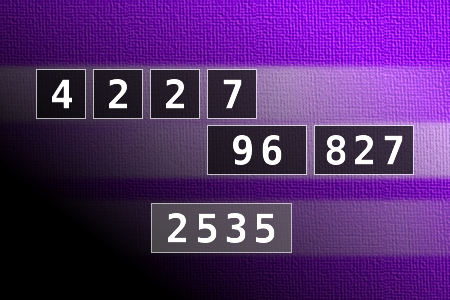
Calculate the number 2535
NUMBERMANIA: Calculate the number 2535 using numbers [4, 2, 2, 7, 96, 827] and basic arithmetic operations (+, -, *, /). Each of the numbers can be used only once.Correct answers: 15
The first user who solved this task is Djordje Timotijevic.
#brainteasers #math #numbermania

Vocabulary
Accountant - Someone who knows the cost of everything and the value of nothing.
Auditor - Someone who arrives after the battle and bayonets all the wounded.
Banker - The fellow who lends you his umbrella when the sun is shining and wants it back the minute it begins to rain. (Mark Twain)
Economist - An expert who will know tomorrow why the things he predicted yesterday didn't happen today.
Statistician - Someone who is good with numbers but lacks the personality to be an accountant.
Actuary - Someone who brings a fake bomb on a plane, because that decreases the chances that there will be another bomb on the plane.
Programmer - Someone who solves a problem you didn't know you had in a way you don't understand.
Mathematician - A blind man in a dark room looking for a black cat which isn't there.
Lawyer - A person who writes a 10,000 word document and calls it a "brief."
Psychologist - A man who watches everyone else when a beautiful girl enters the room.
Schoolteacher - A disillusioned woman who used to think she liked children.
Consultant - Someone who takes the watch off your wrist and tells you the time.
Diplomat - Someone who can tell you to go to hell in such a way that you will look forward to the trip.
Auditor - Someone who arrives after the battle and bayonets all the wounded.
Banker - The fellow who lends you his umbrella when the sun is shining and wants it back the minute it begins to rain. (Mark Twain)
Economist - An expert who will know tomorrow why the things he predicted yesterday didn't happen today.
Statistician - Someone who is good with numbers but lacks the personality to be an accountant.
Actuary - Someone who brings a fake bomb on a plane, because that decreases the chances that there will be another bomb on the plane.
Programmer - Someone who solves a problem you didn't know you had in a way you don't understand.
Mathematician - A blind man in a dark room looking for a black cat which isn't there.
Lawyer - A person who writes a 10,000 word document and calls it a "brief."
Psychologist - A man who watches everyone else when a beautiful girl enters the room.
Schoolteacher - A disillusioned woman who used to think she liked children.
Consultant - Someone who takes the watch off your wrist and tells you the time.
Diplomat - Someone who can tell you to go to hell in such a way that you will look forward to the trip.