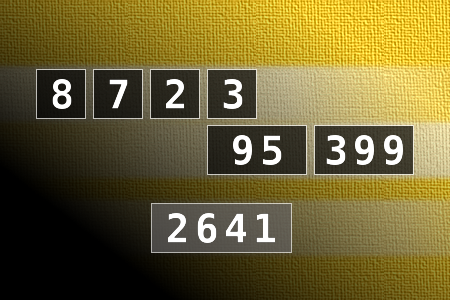
Calculate the number 2641
[3757] Calculate the number 2641 - NUMBERMANIA: Calculate the number 2641 using numbers [8, 7, 2, 3, 95, 399] and basic arithmetic operations (+, -, *, /). Each of the numbers can be used only once. - #brainteasers #math #numbermania - Correct Answers: 25 - The first user who solved this task is Thinh Ddh
BRAIN TEASERS
enter your answer and press button OK

Calculate the number 2641

NUMBERMANIA: Calculate the number 2641 using numbers [8, 7, 2, 3, 95, 399] and basic arithmetic operations (+, -, *, /). Each of the numbers can be used only once.
Correct answers: 25
The first user who solved this task is Thinh Ddh.
#brainteasers #math #numbermania
Register with your Google Account and start collecting points.
Check your ranking on list.

Cotton Candy

So this old man is walking down the street in Brooklyn.

He sees a young boy sitting on the street in front of a candy shop, shoving sweets in his mouth as fast as possible.

The man walks up to the boy and says "You know son, it’s really not healthy to eat all that candy."

The kid looks up at him and says, "You know my grandfather lived to be 97 years old."

The man replies "Oh and did he eat a lot of candy?" The kid looks at him and says "No, but he minded his own fucking business."

Jokes of the day - Daily updated jokes. New jokes every day.
Follow Brain Teasers on social networks

Brain Teasers

puzzles, riddles, mathematical problems, mastermind, cinemania...

Surgery book

In 1561, Ambroise Paré published La méthode curative des playes et fractures de la teste humaine (Treatment Method for Wounds and Fractures of the Human Head). It was written in response to an inquiry following the accidental death of Henri II (1559), who was struck in the eye by a lance during a tournament. The first part (which was reprinted in Paré's Anatomie Universelle, 15 Apr 1561), covered the anatomy of the cranium with woodcut illustrations after Andreas Vesalius. In the second part, Paré described his methods of treatment of head wounds, skull fractures and diseases of the facial organs. The text included abundant figures of his surgical instruments. For his innovative methods, Paré is known as “the father of modern surgery.”
This site uses cookies to store information on your computer. Some are essential to help the site properly. Others give us insight into how the site is used and help us to optimize the user experience. See our privacy policy.