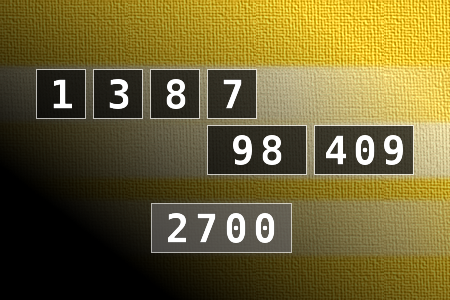

Calculate the number 2700
[6104] Calculate the number 2700 - NUMBERMANIA: Calculate the number 2700 using numbers [1, 3, 8, 7, 98, 409] and basic arithmetic operations (+, -, *, /). Each of the numbers can be used only once. - #brainteasers #math #numbermania - Correct Answers: 11 - The first user who solved this task is Nílton Corrêa de Sousa
BRAIN TEASERS
enter your answer and press button OK

Calculate the number 2700

NUMBERMANIA: Calculate the number 2700 using numbers [1, 3, 8, 7, 98, 409] and basic arithmetic operations (+, -, *, /). Each of the numbers can be used only once.
Correct answers: 11
The first user who solved this task is Nílton Corrêa de Sousa.
#brainteasers #math #numbermania
Register with your Google Account and start collecting points.
Check your ranking on list.

Peanuts

A tour bus driver is driving with a bus load of seniors down a highway when he is tapped on his shoulder by a little old lady. She offers him a handful of peanuts, which he gratefully munches up. After about 15 minutes, she taps him on his shoulder again and she hands him another handful of peanuts. She repeats this gesture about five more times. When she is about to hand him another batch again he asks the little old lady, " Why then don't you eat the peanuts yourself?".
"We can't chew them because we've no teeth," she replied.
The puzzled driver asks, "Why do you buy them then?"
The old lady replied, "We just love the chocolate around them."  

Jokes of the day - Daily updated jokes. New jokes every day.
Follow Brain Teasers on social networks

Brain Teasers

puzzles, riddles, mathematical problems, mastermind, cinemania...

John Ray

Died 17 Jan 1705 at age 77 (born 29 Nov 1627). English naturalist and botanist who was a leader in his field during the 17th-century English and contributed significantly to progress in taxonomy, and is often referred to as the father of natural history in Britain. He toured Europe with Francis Willoughby in search of specimens of flora and fauna. Ray was the first to classify flowering plants into monocotyledons and dicotyledons. Ray established the species as the basic taxonomic unit - his enduring legacy to botany. His major work was the three-volume Historia Plantarum (1686-1704). He also attempted to classify the animal kingdom. In 1693 he published a system based on a number of structural characters, including internal anatomy, which provided a more natural classification than those being produced by his contemporaries.
This site uses cookies to store information on your computer. Some are essential to help the site properly. Others give us insight into how the site is used and help us to optimize the user experience. See our privacy policy.