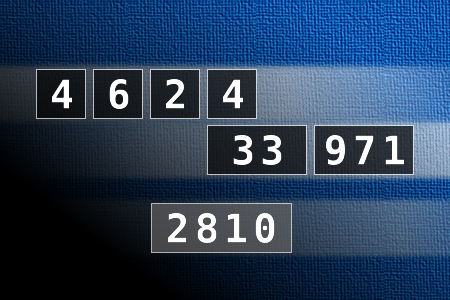
Calculate the number 2810
[7716] Calculate the number 2810 - NUMBERMANIA: Calculate the number 2810 using numbers [4, 6, 2, 4, 33, 971] and basic arithmetic operations (+, -, *, /). Each of the numbers can be used only once. - #brainteasers #math #numbermania - Correct Answers: 2
BRAIN TEASERS
enter your answer and press button OK

Calculate the number 2810

NUMBERMANIA: Calculate the number 2810 using numbers [4, 6, 2, 4, 33, 971] and basic arithmetic operations (+, -, *, /). Each of the numbers can be used only once.
Correct answers: 2
#brainteasers #math #numbermania
Register with your Google Account and start collecting points.
Check your ranking on list.

Blonde Paint Job

A blonde, wanting to earn some money, decided to hire herself out as a handyman-type and started canvassing a wealthy neighborhood. She went to the front door of the first house and asked the owner if he had any jobs for her to do.
"Well, you can paint my porch. How much will you charge?"
The blonde said, "How about 50 dollars?" The man agreed and told her that the paint and ladders that she might need were in the garage. The man's wife, inside the house, heard the conversation and said to her husband, "Does she realize that the porch goes all the way around the house?"
The man replied, "She should. She was standing on the porch."
A short time later, the blonde came to the door to collect her money. "You're finished already?" he asked.
"Yes," the blonde answered, "and I had paint left over, so I gave it two coats. "Impressed, the man reached in his pocket for the $50. "And by the way," the blonde added, "that's not a Porch, it's a Ferrari."
Jokes of the day - Daily updated jokes. New jokes every day.
Follow Brain Teasers on social networks

Brain Teasers

puzzles, riddles, mathematical problems, mastermind, cinemania...

Pierre-Gilles de Gennes

Died 18 May 2007 at age 74 (born 24 Oct 1932).French physicist who was awarded the 1991 Nobel Prize for Physics for "discovering that methods developed for studying order phenomena in simple systems can be generalized to more complex forms of matter, in particular to liquid crystals and polymers." He described mathematically how, for example, magnetic dipoles, long molecules or molecule chains can under certain conditions form ordered states, and what happens when they pass from an ordered to a disordered state. Such changes of order occur when, for example, a heated magnet changes from a state in which all the small atomic magnets are lined up in parallel to a disordered state in which the magnets are randomly oriented. Recently, he has been concerned with the physical chemistry of adhesion.
This site uses cookies to store information on your computer. Some are essential to help the site properly. Others give us insight into how the site is used and help us to optimize the user experience. See our privacy policy.