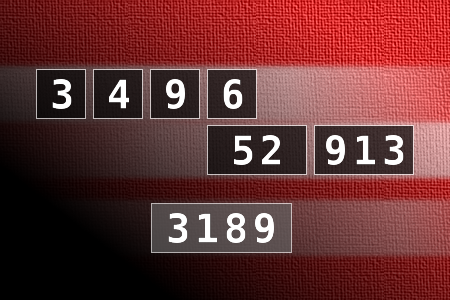
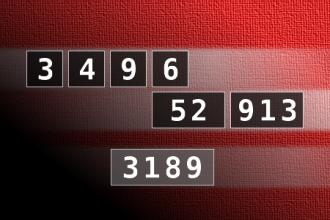
Calculate the number 3189
[2996] Calculate the number 3189 - NUMBERMANIA: Calculate the number 3189 using numbers [3, 4, 9, 6, 52, 913] and basic arithmetic operations (+, -, *, /). Each of the numbers can be used only once. - #brainteasers #math #numbermania - Correct Answers: 30 - The first user who solved this task is Djordje Timotijevic
BRAIN TEASERS
enter your answer and press button OK

Calculate the number 3189

NUMBERMANIA: Calculate the number 3189 using numbers [3, 4, 9, 6, 52, 913] and basic arithmetic operations (+, -, *, /). Each of the numbers can be used only once.
Correct answers: 30
The first user who solved this task is Djordje Timotijevic.
#brainteasers #math #numbermania
Register with your Google Account and start collecting points.
Check your ranking on list.

Because of an ear infection, L...

Because of an ear infection, Little Johnny, had to go to the pediatrician. The doctor directed his comments and questions to Little Johnny in a professional manner. When he asked Little Johnny, "Is there anything you are allergic to?" Little Johnny nodded and whispered in his ear. Smiling, the pediatrician wrote out a prescription and handed it to Little Johnny's mother. She tucked it into her purse without looking at it.
As the pharmacist filled the order, he remarked on the unusual food- drug interaction Little Johnny must have. Little Johnny's mother looked puzzled until he showed her the label on the bottle. As per the doctor's instructions, it read, "Do not take with broccoli."
Jokes of the day - Daily updated jokes. New jokes every day.
Follow Brain Teasers on social networks

Brain Teasers

puzzles, riddles, mathematical problems, mastermind, cinemania...

Charles Louis Fefferman

Born 18 Apr 1949.American mathematician who received the Fields Medal in 1978 for his work in mathematical analysis. As a child prodigy, his accelerated schooling reached B.S. degrees in physics and mathematics by age 17 and a Ph.D. in mathematics from Princeton University at age 20 (1969). By 1971, as a professor at the University of Chicago at age 22, he was the youngest full professor ever in the U.S. Two years later, he returned to Princeton as a professor (1973). His Ph.D. dissertation was on “Inequalities for Strongly Regular Convolution Operators.”His field of study includes his interest in physics - applied mathematics in vibrations, heat, turbulence - though he is best known for his theoretical work.«
This site uses cookies to store information on your computer. Some are essential to help the site properly. Others give us insight into how the site is used and help us to optimize the user experience. See our privacy policy.