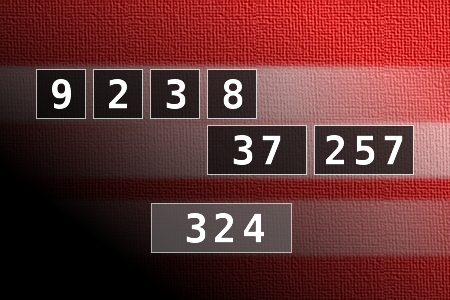
Calculate the number 324
[2851] Calculate the number 324 - NUMBERMANIA: Calculate the number 324 using numbers [9, 2, 3, 8, 37, 257] and basic arithmetic operations (+, -, *, /). Each of the numbers can be used only once. - #brainteasers #math #numbermania - Correct Answers: 40 - The first user who solved this task is Djordje Timotijevic
BRAIN TEASERS
enter your answer and press button OK

Calculate the number 324

NUMBERMANIA: Calculate the number 324 using numbers [9, 2, 3, 8, 37, 257] and basic arithmetic operations (+, -, *, /). Each of the numbers can be used only once.
Correct answers: 40
The first user who solved this task is Djordje Timotijevic.
#brainteasers #math #numbermania
Register with your Google Account and start collecting points.
Check your ranking on list.

Honey, said this husband to his wife...

"Honey," said this husband to his wife, "I invited a friend home for supper."
"What? Are you crazy? The house is a mess, I didn't go shopping, all the dishes are dirty, and I don't feel like cooking a fancy meal!"
"I know all that."
"Then, why did you invite a friend for supper?"
"Because the poor guy is thinking about getting married."
Jokes of the day - Daily updated jokes. New jokes every day.
Follow Brain Teasers on social networks

Brain Teasers

puzzles, riddles, mathematical problems, mastermind, cinemania...

Hydrogen balloon

In 1783, the first manned voyage of a hydrogen balloon left Paris carrying Professor Jacques Alexander Cesar Charles and Marie-Noel Robert to about 600 m and landed 43 km away after 2 hours in the air. Robert then left the balloon, and Charles continued the flight briefly to 2700 m altitude, measured by a barometer. This hydrogen-filled balloon was generally spherical and used a net, load ring, valve, open appendix and sand ballast, all of which were to be universally adopted later. His hydrogen generator mixed huge quantities of sulfuric acid with iron filings. On 27 Aug 1783, Charles had launched an unmanned hydrogen balloon, just before the Montgolfiers' flight.[Image: from 1897 Encyclopedia Britannica]
This site uses cookies to store information on your computer. Some are essential to help the site properly. Others give us insight into how the site is used and help us to optimize the user experience. See our privacy policy.