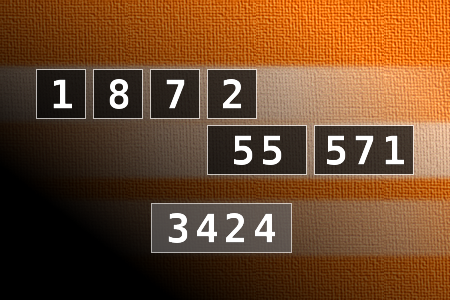
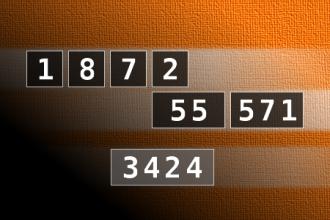
Calculate the number 3424
[7937] Calculate the number 3424 - NUMBERMANIA: Calculate the number 3424 using numbers [1, 8, 7, 2, 55, 571] and basic arithmetic operations (+, -, *, /). Each of the numbers can be used only once. - #brainteasers #math #numbermania - Correct Answers: 0
BRAIN TEASERS
enter your answer and press button OK

Calculate the number 3424

NUMBERMANIA: Calculate the number 3424 using numbers [1, 8, 7, 2, 55, 571] and basic arithmetic operations (+, -, *, /). Each of the numbers can be used only once.
Correct answers: 0
#brainteasers #math #numbermania
Register with your Google Account and start collecting points.
Check your ranking on list.

Cowboy Boots

A lady went into a bar in Waco and saw a cowboy with his feet propped up on a table. He had the biggest boots she'd ever seen.
The woman asked the cowboy if it's true what they say about men with big feet are well endowed.
The cowboy grinned and said, "Shore is, little lady. Why don't you come on out to the bunkhouse and let me prove it to you?"
The woman wanted to find out for herself, so she spent the night with him.
The next morning she handed him a $100 bill.
Blushing, he said, "Well, thankee, ma'am. Ah'm real flattered. Ain't nobody ever paid me fer mah services before."
"Don't be flattered. Take the money and buy yourself some boots that fit."     

Jokes of the day - Daily updated jokes. New jokes every day.
Follow Brain Teasers on social networks

Brain Teasers

puzzles, riddles, mathematical problems, mastermind, cinemania...

Paul Ehrlich

Born 14 Mar 1854; died 20 Aug 1915 at age 61. German medical scientist whose pioneering work in chemotherapy included the discovery of Salvarsan (arsphenamine), the first effective treatment for syphilis against the spirochete Treponema pallidum. His research in the histology of the blood established hematology as a field. Ehrlich also developed new staining methods for microscopic studies on live tissue. At a time when little was understood about the mechanism of disease caused by bacteria, he proposed the side-chain theory as a chemical explanation of immunity, the body's defenses against infection. Though broadly incorrect, the theory nevertheless stimulated further work on the problem. He shared the 1908 Nobel Prize for Physiology or Medicine with Russian bacteriologist, Élie Metchnikoff.
This site uses cookies to store information on your computer. Some are essential to help the site properly. Others give us insight into how the site is used and help us to optimize the user experience. See our privacy policy.