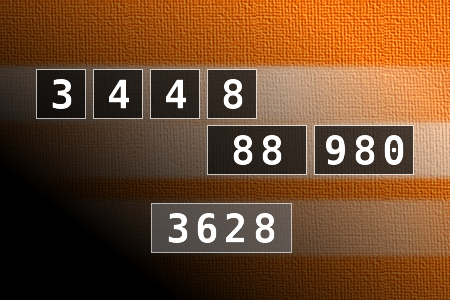
Calculate the number 3628
[7330] Calculate the number 3628 - NUMBERMANIA: Calculate the number 3628 using numbers [3, 4, 4, 8, 88, 980] and basic arithmetic operations (+, -, *, /). Each of the numbers can be used only once. - #brainteasers #math #numbermania - Correct Answers: 3
BRAIN TEASERS
enter your answer and press button OK

Calculate the number 3628

NUMBERMANIA: Calculate the number 3628 using numbers [3, 4, 4, 8, 88, 980] and basic arithmetic operations (+, -, *, /). Each of the numbers can be used only once.
Correct answers: 3
#brainteasers #math #numbermania
Register with your Google Account and start collecting points.
Check your ranking on list.

A golfer, who was known for hi...

A golfer, who was known for his bad temper, walked into the Pro Shop one day and plunked down big bucks for a new set of woods.
The staff all watched to see what would happen after he used them for the first time - more than half expecting he'd come in and demand his money back.
But the next time he came in, he was all smiles.
"They're the best clubs I've ever had," he said. "In fact, I've discovered I can throw them at least 40 yards farther than I could my last ones."
Jokes of the day - Daily updated jokes. New jokes every day.
Follow Brain Teasers on social networks

Brain Teasers

puzzles, riddles, mathematical problems, mastermind, cinemania...

Baron C.P. Snow

Born 15 Oct 1905; died 1 Jul 1980 at age 74. Baron Charles Percy Snow was an English physicist, novelist and government administrator who had an active, varied career. In his controversial 1959 Rede Lecture called The Two Cultures and the Scientific Revolution, he claimed there were two cultures—the literary intellectuals and the scientists—who didn't understand each other and didn't trust each other. The split was not new; Snow noted that in the 1930s, literary theorists had begun to use the word “intellectual”to refer only to themselves. He illustrated this gap by asking a group of literary intellectuals to tell him about the Second Law of Thermodynamics, which he called the scientific equivalent of “Have you read a work of Shakespeare?”Since then, debate about this polarization has continued.
This site uses cookies to store information on your computer. Some are essential to help the site properly. Others give us insight into how the site is used and help us to optimize the user experience. See our privacy policy.