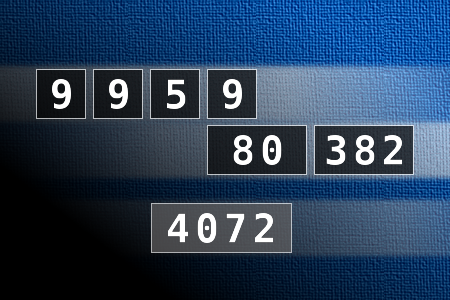
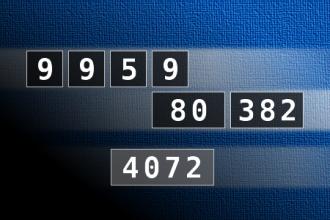
Calculate the number 4072
[8200] Calculate the number 4072 - NUMBERMANIA: Calculate the number 4072 using numbers [9, 9, 5, 9, 80, 382] and basic arithmetic operations (+, -, *, /). Each of the numbers can be used only once. - #brainteasers #math #numbermania - Correct Answers: 1
BRAIN TEASERS
enter your answer and press button OK

Calculate the number 4072

NUMBERMANIA: Calculate the number 4072 using numbers [9, 9, 5, 9, 80, 382] and basic arithmetic operations (+, -, *, /). Each of the numbers can be used only once.
Correct answers: 1
#brainteasers #math #numbermania
Register with your Google Account and start collecting points.
Check your ranking on list.

Smashing The Cigarettes

A carpet layer had just finished installing carpet for a lady. He stepped out for a smoke, only to realize he'd lost his cigarettes. In the middle of the room, under the carpet, was a bump. "No sense pulling up the entire floor for one pack of smokes," he said to himself. He proceeded to get out his hammer and flattened the hump.
As he was cleaning up, the lady came in. "Here," she said, handing him his pack of cigarettes. "I found them in the hallway." "Now," she said, "if only I could find my gerbil."

Jokes of the day - Daily updated jokes. New jokes every day.
Follow Brain Teasers on social networks

Brain Teasers

puzzles, riddles, mathematical problems, mastermind, cinemania...

Robert B. Laughlin

Born 1 Nov 1950.American physicist whoshared(with Daniel C. Tsui and Horst Störmer) the Nobel Prize for Physics in 1998 for research on the fractional quantum Hall effect. In a current-carrying conductor, the classic Hall effect is the voltage produced at right angles to a magnetic field, as first discovered in 1879. A century later the German physicist Klaus von Klitzing discovered that in a powerful magnetic field at extremely low temperatures the Hall resistance of a semiconductor is quantized in integral “steps.” Using even stronger magnetic fields and lower temperatures, Störmer and Tsui discovered fractional steps, explained by Laughlin's theory that the electrons can form a new type of quantum fluid with quasiparticles carrying fractions of an electron's charge.
This site uses cookies to store information on your computer. Some are essential to help the site properly. Others give us insight into how the site is used and help us to optimize the user experience. See our privacy policy.