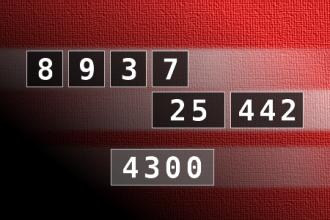
Calculate the number 4300
[6603] Calculate the number 4300 - NUMBERMANIA: Calculate the number 4300 using numbers [8, 9, 3, 7, 25, 442] and basic arithmetic operations (+, -, *, /). Each of the numbers can be used only once. - #brainteasers #math #numbermania - Correct Answers: 7 - The first user who solved this task is Nasrin 24 T
BRAIN TEASERS
enter your answer and press button OK

Calculate the number 4300

NUMBERMANIA: Calculate the number 4300 using numbers [8, 9, 3, 7, 25, 442] and basic arithmetic operations (+, -, *, /). Each of the numbers can be used only once.
Correct answers: 7
The first user who solved this task is Nasrin 24 T.
#brainteasers #math #numbermania
Register with your Google Account and start collecting points.
Check your ranking on list.

What Deep Thinkers Men Are

I mowed the lawn today, and after doing so I sat down and had a cold beer. The day was really quite beautiful, and the drink facilitated some deep thinking on various topics.
Finally I thought about an age old question:

Is giving birth more painful than getting kicked in the nuts?
Women always maintain that giving birth is way more painful than a guy getting kicked in the nuts.
Well, after another beer, and some heavy deductive thinking, I have come up with the answer to that question.
Getting kicked in the nuts is more painful than having a baby; and here is the reason for my conclusion.
A year or so after giving birth, a woman will often say, "It might be nice to have another child."
On the other hand, you never hear a guy say, "You know, I think I would like another kick in the nuts."
I rest my case.
Time for another beer.

Jokes of the day - Daily updated jokes. New jokes every day.
Follow Brain Teasers on social networks

Brain Teasers

puzzles, riddles, mathematical problems, mastermind, cinemania...

Ronald G.W. Norrish

Born 9 Nov 1897; died 7 Jun 1978 at age 80.Ronald George Wreyford Norrish was a British chemist who shared the 1967 Nobel Prize for Chemistry with fellow Englishman Sir George Porter and German Manfred Eigen for their studies of very fast chemical reactions. From 1949-65 he collaborated with his former pupil George Porter in the development of flash photolysis and kinetic spectroscopy for the investigation of very fast reactions. Norrish also made a significant contribution to chemistry when he corrected Draper's law. In the mid-19th century John Draper proposed that the amount of photochemical change is proportional to the intensity of the light multiplied by the time for which it acts. Norrish showed that the rate was in fact proportional to the square root of the light intensity.
This site uses cookies to store information on your computer. Some are essential to help the site properly. Others give us insight into how the site is used and help us to optimize the user experience. See our privacy policy.