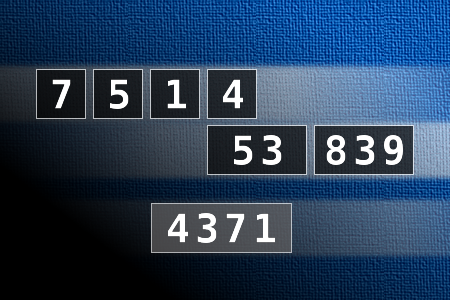
Calculate the number 4371
[2827] Calculate the number 4371 - NUMBERMANIA: Calculate the number 4371 using numbers [7, 5, 1, 4, 53, 839] and basic arithmetic operations (+, -, *, /). Each of the numbers can be used only once. - #brainteasers #math #numbermania - Correct Answers: 35 - The first user who solved this task is Manguexa Wagle
BRAIN TEASERS
enter your answer and press button OK

Calculate the number 4371

NUMBERMANIA: Calculate the number 4371 using numbers [7, 5, 1, 4, 53, 839] and basic arithmetic operations (+, -, *, /). Each of the numbers can be used only once.
Correct answers: 35
The first user who solved this task is Manguexa Wagle.
#brainteasers #math #numbermania
Register with your Google Account and start collecting points.
Check your ranking on list.

Government Employee

A United State Government Employee sits in his office and out of boredom, decides to see what's in his old filing cabinet. He pokes through the contents and comes across an old brass lamp.

"This will look nice on my mantelpiece," he decides, and takes it home with him.

While polishing the lamp, a genie appears and grants him three wishes. "I wish for an ice cold diet Coke right now!"

He gets his Coke and drinks it.

Now that he can think more clearly, he states his second wish. "I wish to be on an island where beautiful nymphomaniacs reside." Suddenly he is on an island with gorgeous females eyeing him lustfully.

He tells the genie his third and last wish. "I wish I'd never have to work ever again."

POOF! He's back in his government office.

Jokes of the day - Daily updated jokes. New jokes every day.
Follow Brain Teasers on social networks

Brain Teasers

puzzles, riddles, mathematical problems, mastermind, cinemania...

Helium liquefied

In 1908, Kamerlingh Onnes made helium liquid at a temperature of 4.2 K (about -269 ºC). He had worked for many years to liquify this element which persisted as a gas to the lowest temperature. Using liquid air to produce liquid hydrogen and then the hydrogen to jacket the liquification apparatus, he produced about 60 cubic centimeters of liquid helium. The gas was liquefied by compressing it, cooling it below the inversion temperature and then allowing it to expand, which causes further cooling resulting in the liquefaction of some of the gas. At his cryogenic laboratory, he had previously liquefied air (1892) in large quantities, and built a large hydrogen liquefier (1906). Onnes received the Nobel Prize in 1913 for his low temperature work.
This site uses cookies to store information on your computer. Some are essential to help the site properly. Others give us insight into how the site is used and help us to optimize the user experience. See our privacy policy.