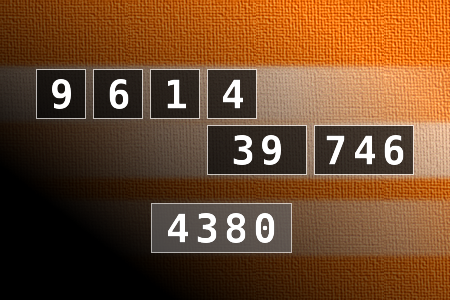
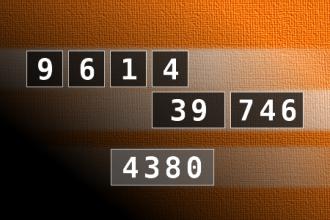
Calculate the number 4380
[5195] Calculate the number 4380 - NUMBERMANIA: Calculate the number 4380 using numbers [9, 6, 1, 4, 39, 746] and basic arithmetic operations (+, -, *, /). Each of the numbers can be used only once. - #brainteasers #math #numbermania - Correct Answers: 13 - The first user who solved this task is Djordje Timotijevic
BRAIN TEASERS
enter your answer and press button OK

Calculate the number 4380

NUMBERMANIA: Calculate the number 4380 using numbers [9, 6, 1, 4, 39, 746] and basic arithmetic operations (+, -, *, /). Each of the numbers can be used only once.
Correct answers: 13
The first user who solved this task is Djordje Timotijevic.
#brainteasers #math #numbermania
Register with your Google Account and start collecting points.
Check your ranking on list.

Knock Knock Collection 194

Knock Knock
Who's there?
Wilfred!
Wilfred who?
Wilfred like his present?
Knock Knock
Who's there?
Willa!
Willa who?
Willa you marry me!
Knock Knock
Who's there?
William!
William who?
William-ind your own business!
Knock Knock
Who's there?
Willie!
Willie who?
Willie be home for dinner!
Knock Knock
Who's there?
Willis!
Willis who?
Willis rain ever stop!
Jokes of the day - Daily updated jokes. New jokes every day.
Follow Brain Teasers on social networks

Brain Teasers

puzzles, riddles, mathematical problems, mastermind, cinemania...

Kasimir Fajans

Died 18 May 1975 at age 87 (born 27 May 1887). Polish-American physical chemist who discovered the radioactive displacement law simultaneously with Frederick Soddy of Great Britain. According to this law, when a radioactive atom decays by emitting an alpha particle, the atomic number of the resulting atom is two fewer than that of the parent atom. He discovered several elements that are created through nuclear disintegration. The first discovery of protactinium was in 1913 by Kasimir Fajans and O. Göhring, who found the isotope protactinium-234m (half-life 1.2 min), a decay product of uranium-238; they named it brevium for its short life. (Protactinium-231 was later identified in 1918 by other scientists; the name protoactinium was adopted at this time.)
This site uses cookies to store information on your computer. Some are essential to help the site properly. Others give us insight into how the site is used and help us to optimize the user experience. See our privacy policy.