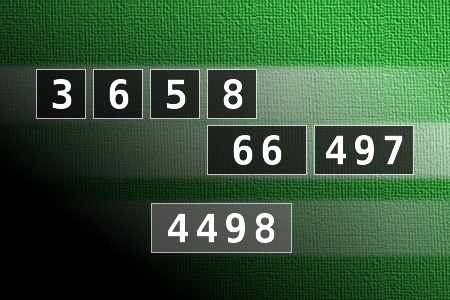
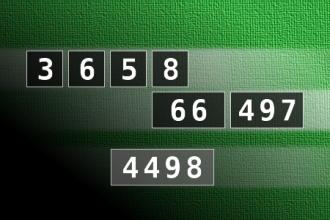
Calculate the number 4498
[5917] Calculate the number 4498 - NUMBERMANIA: Calculate the number 4498 using numbers [3, 6, 5, 8, 66, 497] and basic arithmetic operations (+, -, *, /). Each of the numbers can be used only once. - #brainteasers #math #numbermania - Correct Answers: 12 - The first user who solved this task is Nílton Corrêa De Sousa
BRAIN TEASERS
enter your answer and press button OK

Calculate the number 4498

NUMBERMANIA: Calculate the number 4498 using numbers [3, 6, 5, 8, 66, 497] and basic arithmetic operations (+, -, *, /). Each of the numbers can be used only once.
Correct answers: 12
The first user who solved this task is Nílton Corrêa De Sousa.
#brainteasers #math #numbermania
Register with your Google Account and start collecting points.
Check your ranking on list.

Complete and Finished

There is a subtle but important difference between the words "complete" and "finished."

When you marry the right one, you are complete.

When you marry the wrong one, you are finished.

And if the right one catches you with the wrong one, you are completely finished.

Jokes of the day - Daily updated jokes. New jokes every day.
Follow Brain Teasers on social networks

Brain Teasers

puzzles, riddles, mathematical problems, mastermind, cinemania...

Peter Barlow

Born 13 Oct 1776; died 1 Mar 1862 at age 85. English mathematician and engineer who invented two varieties of achromatic (non-colour-distorting) telescope lenses. In 1819, Barlow began work on the problem of deviation in ship compasses caused by the presence of iron in the hull. For his method of correcting the deviation by juxtaposing the compass with a suitably shaped piece of iron, he was awarded the Copley Medal. In 1822, he built a device which is to be considered one of the first models of an electric motor supplied by continuous current. He also worked on the design of bridges, in particular working (1819-26) with Thomas Telford on the design of the bridge over the Menai Strait, the first major modern suspension bridge. Barlow was active during the period of railway building in Britain.
This site uses cookies to store information on your computer. Some are essential to help the site properly. Others give us insight into how the site is used and help us to optimize the user experience. See our privacy policy.