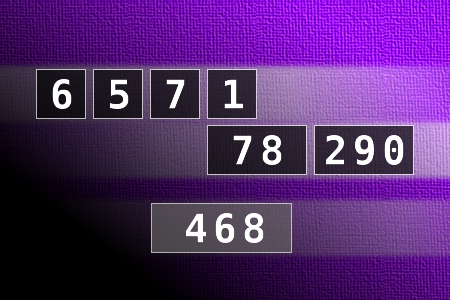
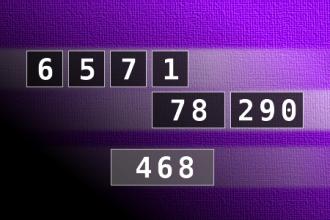
Calculate the number 468
[3824] Calculate the number 468 - NUMBERMANIA: Calculate the number 468 using numbers [6, 5, 7, 1, 78, 290] and basic arithmetic operations (+, -, *, /). Each of the numbers can be used only once. - #brainteasers #math #numbermania - Correct Answers: 22 - The first user who solved this task is Manguexa Wagle
BRAIN TEASERS
enter your answer and press button OK

Calculate the number 468

NUMBERMANIA: Calculate the number 468 using numbers [6, 5, 7, 1, 78, 290] and basic arithmetic operations (+, -, *, /). Each of the numbers can be used only once.
Correct answers: 22
The first user who solved this task is Manguexa Wagle.
#brainteasers #math #numbermania
Register with your Google Account and start collecting points.
Check your ranking on list.

Staring at the orange juice

In the morning, a blonde enters a restaurant with a carton of orange juice. She puts the orange juice on the table and stares at it.
The store is about to close down and the blonde is still staring at the orange juice. A waiter comes and asks the blonde, "Excuse me, we are about to close for the evening, I'm afraid your going to have to leave."
"No," the blonde replies.
"Why not?" questions the waiter.
"The carton says 'concentrate'".
Jokes of the day - Daily updated jokes. New jokes every day.
Follow Brain Teasers on social networks

Brain Teasers

puzzles, riddles, mathematical problems, mastermind, cinemania...

Thomas Gold

Born 22 May 1920; died 22 Jun 2004 at age 84. Austrian-British-American astronomer known for a steady-state theory of the universe, explaining pulsars, and naming the magnetosphere. In 1948, as a graduate student at Cambridge, he (together with Hermann Bondi and Fred Hoyle) proposed that, a continuous creation of matter in space is gradually forming new galaxies, maintaining the average number of galaxies in any part of the universe, despite its expansion. This is not accepted, as there is more evidence for the Big Bang theory. In 1967, Gold presented his theory on the nature of pulsars (objects in deep space that produce regularly pulsing radio waves). He suggested that they were rotating neutron stars - tiny, extraordinarily massive stars - which emit waves as they spin.
This site uses cookies to store information on your computer. Some are essential to help the site properly. Others give us insight into how the site is used and help us to optimize the user experience. See our privacy policy.