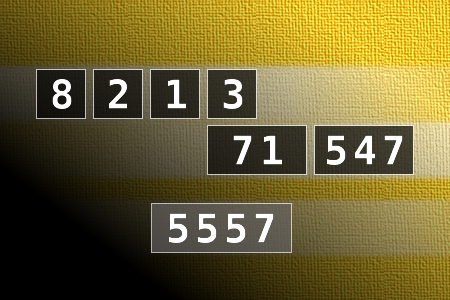
Calculate the number 5557
[3012] Calculate the number 5557 - NUMBERMANIA: Calculate the number 5557 using numbers [8, 2, 1, 3, 71, 547] and basic arithmetic operations (+, -, *, /). Each of the numbers can be used only once. - #brainteasers #math #numbermania - Correct Answers: 33 - The first user who solved this task is Snezana Milanovic
BRAIN TEASERS
enter your answer and press button OK

Calculate the number 5557

NUMBERMANIA: Calculate the number 5557 using numbers [8, 2, 1, 3, 71, 547] and basic arithmetic operations (+, -, *, /). Each of the numbers can be used only once.
Correct answers: 33
The first user who solved this task is Snezana Milanovic.
#brainteasers #math #numbermania
Register with your Google Account and start collecting points.
Check your ranking on list.

Half-Fare Special

One of the airlines recently introduced a special half-fare rate for wives accompanying their husbands on business trips.
Anticipating some valuable testimonials, the publicity department of the airline sent out letters to all the wives of businessmen who used the special rates, asking how they enjoyed their trip.

Responses are still pouring in asking, "What trip?"        

Jokes of the day - Daily updated jokes. New jokes every day.
Follow Brain Teasers on social networks

Brain Teasers

puzzles, riddles, mathematical problems, mastermind, cinemania...

Henry Horatio Dixon

Died 20 Dec 1953 at age 84 (born 19 May 1869).Irish botanist who, with John Joly, investigated plant transpiration and originated the tension theory of sap ascent in trees (1894) building on the work of Eduard Strasburger, François Donny and Berthelot. Dixon's earlier work was in cytology and had developed sterile culture methods for seedlings (1892). After the 1894 publication, he made further transpiration experiments to consolidate his theory which he published in 1909 and 1914. He resolved the debate over the mechanism of xylem transport by proposing a compromise between the pulling power of the leaf and the tensile strength of the water columns. From 1910, he was curator of a new herbarium at Trinity College Dublin.«
This site uses cookies to store information on your computer. Some are essential to help the site properly. Others give us insight into how the site is used and help us to optimize the user experience. See our privacy policy.