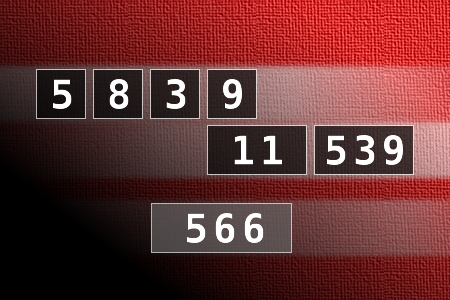
Calculate the number 566
[3583] Calculate the number 566 - NUMBERMANIA: Calculate the number 566 using numbers [5, 8, 3, 9, 11, 539] and basic arithmetic operations (+, -, *, /). Each of the numbers can be used only once. - #brainteasers #math #numbermania - Correct Answers: 32 - The first user who solved this task is Eugenio G. F. de Kereki
BRAIN TEASERS
enter your answer and press button OK

Calculate the number 566

NUMBERMANIA: Calculate the number 566 using numbers [5, 8, 3, 9, 11, 539] and basic arithmetic operations (+, -, *, /). Each of the numbers can be used only once.
Correct answers: 32
The first user who solved this task is Eugenio G. F. de Kereki.
#brainteasers #math #numbermania
Register with your Google Account and start collecting points.
Check your ranking on list.

Bill, Jim, and Scott were at a...

Bill, Jim, and Scott were at a convention together and were sharing a large suite on the top of a 75-story skyscraper. After a long day of meetings they were shocked to hear that the elevators in their hotel were broken and they would have to climb 75 flights of stairs to get to their room. Bill said to Jim and Scott, let's break the monotony of this unpleasant task by concentrating on something interesting. I'll tell jokes for 25 flights, and Jim can sing songs for 25 flights, and Scott can tell sad stories the rest of the way. At the 26th floor Bill stopped telling jokes and Jim began to sing. At the 51st floor Jim stopped singing and Scott began to tell sad stories. "I will tell my saddest story first," he said. "I left the room key in the car!"
Jokes of the day - Daily updated jokes. New jokes every day.
Follow Brain Teasers on social networks

Brain Teasers

puzzles, riddles, mathematical problems, mastermind, cinemania...

J. Carson Mark

Died 2 Mar 1997 at age 83 (born 6 Jul 1913).Canadian-American scientist who, as head of the theoretical division at the Los Alamos (N.M.) Scientific Laboratory, was involved in the development of various weapons systems, including thermonuclear bombs. He began at Los Alamos in 1945 as a collaborator on the Manhattan Project. He joined the staff in 1946 and became leader of T Division the following year until his retirement in 1973. He had a broad range of research interests, including hydrodynamics, neutron physics and transport theory. By the 1960s, much of the weapons work had been relocated and the T division diversified into working with outside agencies and private industry. After his retirement, he was active in issues related to disarmament and nonproliferation.«
This site uses cookies to store information on your computer. Some are essential to help the site properly. Others give us insight into how the site is used and help us to optimize the user experience. See our privacy policy.