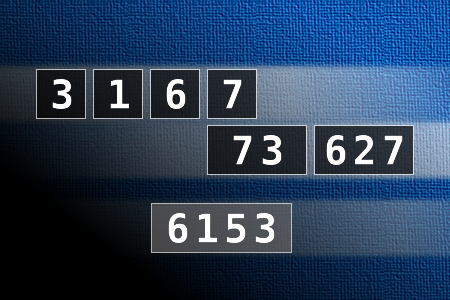
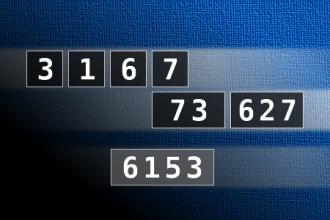
Calculate the number 6153
[4362] Calculate the number 6153 - NUMBERMANIA: Calculate the number 6153 using numbers [3, 1, 6, 7, 73, 627] and basic arithmetic operations (+, -, *, /). Each of the numbers can be used only once. - #brainteasers #math #numbermania - Correct Answers: 20 - The first user who solved this task is Manguexa Wagle
BRAIN TEASERS
enter your answer and press button OK

Calculate the number 6153

NUMBERMANIA: Calculate the number 6153 using numbers [3, 1, 6, 7, 73, 627] and basic arithmetic operations (+, -, *, /). Each of the numbers can be used only once.
Correct answers: 20
The first user who solved this task is Manguexa Wagle.
#brainteasers #math #numbermania
Register with your Google Account and start collecting points.
Check your ranking on list.

Long lines everywhere

There was a guy in high school that landed a date with the hottest girl in class for the prom.
First, he went to pick out a suit, and had to wait in a huge line.
Then he went and picked out flowers, and waited in a huge line.
Even when he called around for limo's, he had to wait in hold lines for all of them.
Getting ready for after the prom, there was even a long line at the pharmacy.
Finally the big night arrives and he takes his dance to the prom. When they get there, he asks his date if she wants him to get drink and she says yes.
Much to his surprise, there was no punch line.
Jokes of the day - Daily updated jokes. New jokes every day.
Follow Brain Teasers on social networks

Brain Teasers

puzzles, riddles, mathematical problems, mastermind, cinemania...

Edison patent

In 1924, Thomas A. Edison was issued a patent for a “Method of Producing Chlorinated Rubber” (U.S. No. 1,495,580), which claimed to be more economical than earlier methods. Natural rubber readily degrades and becomes brittle in the presence of oxygen or ozone in the air. Chlorine is used to replace some hydrogen atoms in the surface molecules of the rubber making it more stable. Edison's method treated very thin rubber strips in a chamber with chlorine gas mixed with the vapour of a highly chlorinated solvent of rubber such as carbon tetrachloride to soften the rubber surface for increased penetration by the gaseous chlorine, followed by other processing. In his patent, Edison envisioned further processing it with naphthaline and fillers, for use as a tough, hard veneer for phonograph records or cylinders.«
This site uses cookies to store information on your computer. Some are essential to help the site properly. Others give us insight into how the site is used and help us to optimize the user experience. See our privacy policy.