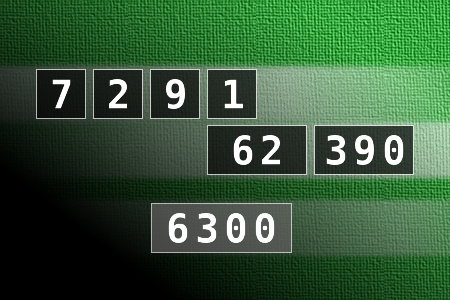
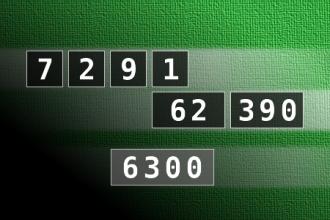
Calculate the number 6300
[8384] Calculate the number 6300 - NUMBERMANIA: Calculate the number 6300 using numbers [7, 2, 9, 1, 62, 390] and basic arithmetic operations (+, -, *, /). Each of the numbers can be used only once. - #brainteasers #math #numbermania - Correct Answers: 1
BRAIN TEASERS
enter your answer and press button OK

Calculate the number 6300

NUMBERMANIA: Calculate the number 6300 using numbers [7, 2, 9, 1, 62, 390] and basic arithmetic operations (+, -, *, /). Each of the numbers can be used only once.
Correct answers: 1
#brainteasers #math #numbermania
Register with your Google Account and start collecting points.
Check your ranking on list.

National Geographic

Ole and Lena are 69-ing when Ole says, "Lena, did you know there are 117,000 musk ox in Alaska?"

Lena says, "No, I didn't."

Ole says, "And Lena, did you know there are 482,000 grizzly bears living in Alaska?"

Lena says, "No, I didn't. Gee, you're smart."

Ole says, "And Lena, did you know there are more than 2 million caribou living in Alaska?"

"No," says Lena, wondering how this conversation came about in the middle of their sex play.

"How did you get so smart?"

Ole says, "Remember last night when we ran out of toilet paper and had to use the pages out of magazines?"

"Yes, I remember," says Lena.

"Well, you still have page 63 of National Geographic stuck to your ass."

Jokes of the day - Daily updated jokes. New jokes every day.
Follow Brain Teasers on social networks

Brain Teasers

puzzles, riddles, mathematical problems, mastermind, cinemania...

Albert S. Bickmore

Born 1 Mar 1839; died 12 Aug 1914 at age 75.Albert Smith Bickmore was an American naturalist, traveller and museum curator who acquired his love of natural history as a result of growing up in a coastal town. He studied natural history under Professor Agassiz, and shortly also began to care for the department of Mullusca at the Museum of Comparative Zoology at Harvard University. There he conceived the idea of the American Museum of Natural History. By 1865, he set off on a three-year expedition to the East Indies, China, Japan, Russia and Europe gathering specimens to form the basis of the future museum's collection. Upon his return, he devoted himself to indeed establishing the institution, and was able to arrange for its funding. He wrote of his travels in Travels in the East Indian Archipelago (1869). In 1870, he was appointed Professor Natural History at Madison University, Hamilton, New York. The cornerstone of the new building was laid on 2 Jun 1874, by President Grant.«
This site uses cookies to store information on your computer. Some are essential to help the site properly. Others give us insight into how the site is used and help us to optimize the user experience. See our privacy policy.