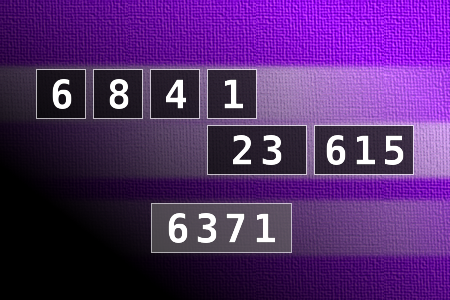
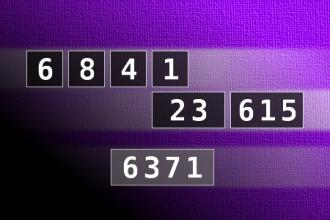
Calculate the number 6371
[7688] Calculate the number 6371 - NUMBERMANIA: Calculate the number 6371 using numbers [6, 8, 4, 1, 23, 615] and basic arithmetic operations (+, -, *, /). Each of the numbers can be used only once. - #brainteasers #math #numbermania - Correct Answers: 1
BRAIN TEASERS
enter your answer and press button OK

Calculate the number 6371

NUMBERMANIA: Calculate the number 6371 using numbers [6, 8, 4, 1, 23, 615] and basic arithmetic operations (+, -, *, /). Each of the numbers can be used only once.
Correct answers: 1
#brainteasers #math #numbermania
Register with your Google Account and start collecting points.
Check your ranking on list.

A lawyer calls a plumber for help...

The plumber assesses the situation and says, "I can fix it today for $800."

The lawyer, surprised, asks, "How long will it take?" The plumber replies, "I'll need about an hour to get a part from the supply house and another hour to do the repair."

The lawyer, smirking, says, "Two hours for $800? That's $400 per hour! I'm a lawyer, and I charge $350 per hour!"

The plumber nods and says, "Yes, I understand. That's why I left my law practice."

Jokes of the day - Daily updated jokes. New jokes every day.
Follow Brain Teasers on social networks

Brain Teasers

puzzles, riddles, mathematical problems, mastermind, cinemania...

Johann Wolfgang von Goethe

Died 22 Mar 1832 at age 82 (born 28 Aug 1749). German poet, zoologist, botanist and geologist who was both famous in world literature and an intellectual with an interest in science. He coined the term morphology to describe the systematic study of the structure of living things. He wrote ably, though mostly wrongly, on matters of science. His Zur Farbenlehre (On the Theory of Colour, 1810), parted radically from Newton's interpretation of white light as a mixture of colours. Goethe took the position of a neptunist in geology. In biology, he saw all plant structures as modifications of leaf forms. However, he agreed with evolution whereby he viewed the origin of plants and animals as having followed specialization and differentiation throughout time to their present forms.«
This site uses cookies to store information on your computer. Some are essential to help the site properly. Others give us insight into how the site is used and help us to optimize the user experience. See our privacy policy.