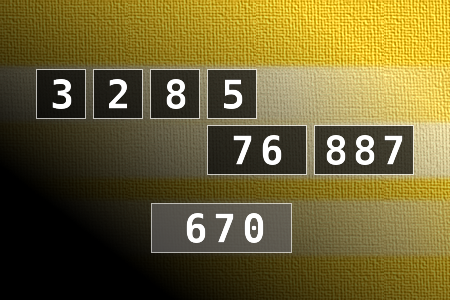
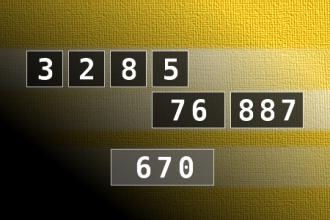
Calculate the number 670
[5504] Calculate the number 670 - NUMBERMANIA: Calculate the number 670 using numbers [3, 2, 8, 5, 76, 887] and basic arithmetic operations (+, -, *, /). Each of the numbers can be used only once. - #brainteasers #math #numbermania - Correct Answers: 27 - The first user who solved this task is Djordje Timotijevic
BRAIN TEASERS
enter your answer and press button OK

Calculate the number 670

NUMBERMANIA: Calculate the number 670 using numbers [3, 2, 8, 5, 76, 887] and basic arithmetic operations (+, -, *, /). Each of the numbers can be used only once.
Correct answers: 27
The first user who solved this task is Djordje Timotijevic.
#brainteasers #math #numbermania
Register with your Google Account and start collecting points.
Check your ranking on list.

Not speaking...

Following an especially angry argument, Mr. and Mrs. Smith went to bed not speaking to each other. Needing to arise early the following morning, Mr. Smith left a note on his wife's bedside table that said "Wake me at six."

An exasperated Mr. Smith awoke at ten the following morning and rolled stiffly out of bed to see a note on his bedside table: "It's six, you bum! Get out of bed!"

Jokes of the day - Daily updated jokes. New jokes every day.
Follow Brain Teasers on social networks

Brain Teasers

puzzles, riddles, mathematical problems, mastermind, cinemania...

Karl Taylor Compton

Born 14 Sep 1887; died 22 Jun 1954 at age 66.American educator and physicist who directed development of radar during WW II. His research included the passage of photoelectrons through metals, ionization and the motion of electrons in gases, fluorescence, the theory of the electric arc, and collisions of electrons and atoms. In 1933, President Roosevelt asked him to chair the new Scientific Advisory Board. When the National Defense Research Committee was formed in 1940, he was chief of Division D (detection: radar, fire control, etc.) In 1941, he was in charge of those divisions concerned with radar within the new Office of Scientific Research and Development (OSRD). Afterwards he was cited for personally shortening the duration of the war. He was the first recipient William Procter Prize for Scientific Achievement, and brother of Arthur H. Compton.
This site uses cookies to store information on your computer. Some are essential to help the site properly. Others give us insight into how the site is used and help us to optimize the user experience. See our privacy policy.