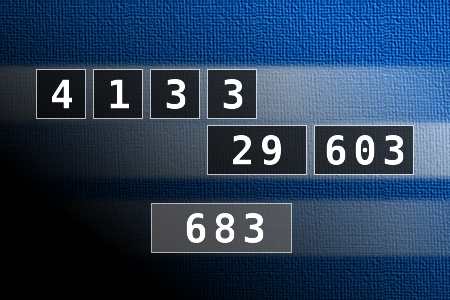
Calculate the number 683
[5218] Calculate the number 683 - NUMBERMANIA: Calculate the number 683 using numbers [4, 1, 3, 3, 29, 603] and basic arithmetic operations (+, -, *, /). Each of the numbers can be used only once. - #brainteasers #math #numbermania - Correct Answers: 19 - The first user who solved this task is Djordje Timotijevic
BRAIN TEASERS
enter your answer and press button OK

Calculate the number 683

NUMBERMANIA: Calculate the number 683 using numbers [4, 1, 3, 3, 29, 603] and basic arithmetic operations (+, -, *, /). Each of the numbers can be used only once.
Correct answers: 19
The first user who solved this task is Djordje Timotijevic.
#brainteasers #math #numbermania
Register with your Google Account and start collecting points.
Check your ranking on list.

The Eight Iron

Off the seventh tee, Joe sliced his shot deep into a wooded ravine. He took his eight iron and clambered down the embankment in search of his lost ball. After many long minutes of hacking at the underbrush, he spotted something glistening in the leaves. As he drew nearer, he discovered that it was an eight iron in hands of a skeleton!
Joe immediately called out to his friend, 'Jack, I've got trouble down here!'
'What's the matter?' Jack asked from the edge of the ravine.
'Bring me my wedge,' Joe shouted. 'You can't get out of here with an eight iron!'

Jokes of the day - Daily updated jokes. New jokes every day.
Follow Brain Teasers on social networks

Brain Teasers

puzzles, riddles, mathematical problems, mastermind, cinemania...

Andrey Andreyevich Markov

Died 20 Jul 1922 at age 66 (born 14 Jun 1856).Russian mathematician who helped to develop the theory of stochastic processes, especially those called Markov chains, sequences of random variables in which the future variable is determined by the present variable but is independent of the way in which the present state arose from its predecessors. (For example, the probability of winning at the game of Monopoly can be determined using Markov chains.) His work based on the study of the probability of mutually dependent events has been developed and widely applied to the biological and social sciences.
This site uses cookies to store information on your computer. Some are essential to help the site properly. Others give us insight into how the site is used and help us to optimize the user experience. See our privacy policy.