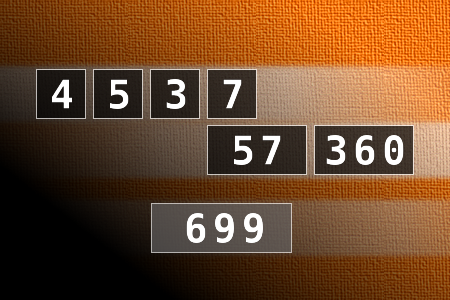

Calculate the number 699
[4375] Calculate the number 699 - NUMBERMANIA: Calculate the number 699 using numbers [4, 5, 3, 7, 57, 360] and basic arithmetic operations (+, -, *, /). Each of the numbers can be used only once. - #brainteasers #math #numbermania - Correct Answers: 18 - The first user who solved this task is Manguexa Wagle
BRAIN TEASERS
enter your answer and press button OK

Calculate the number 699

NUMBERMANIA: Calculate the number 699 using numbers [4, 5, 3, 7, 57, 360] and basic arithmetic operations (+, -, *, /). Each of the numbers can be used only once.
Correct answers: 18
The first user who solved this task is Manguexa Wagle.
#brainteasers #math #numbermania
Register with your Google Account and start collecting points.
Check your ranking on list.

Cannibals

One day three people were stuck on an island with cannibals.

The cannibals said, "If you do what we say, we won’t kill you".

So the 3 people followed the orders which were to go into the forest and pick 10 fruits of your choice.

So the first person came back out of the forest with 10 apples. The cannibals said, "put the apples up your ass without making a facial expression". The person held his composure however then made a facial expression after the second apple, so the cannibals killed him.

The second person came back out of the forest with 10 cherries. The cannibals said, "put the cherries up your ass without making a facial expression". However as much as he tried to restrain himself the person burst into tears laughing on the tenth cherry, so they killed him.

In heaven, the person with apples asked the person with cherries "why did you start laughing?"

The person replied, "I saw the third person come out with pineapples."

Jokes of the day - Daily updated jokes. New jokes every day.
Follow Brain Teasers on social networks

Brain Teasers

puzzles, riddles, mathematical problems, mastermind, cinemania...

John Mercer

Died 30 Nov 1866 at age 75 (born 21 Feb 1791).English chemist and industrialist who invented the mercerisation process for treating cotton which is still in use today and was a pioneer in colour photography. From age 16, and throughout his life, he investigated and developed chemical textile dyes. Late in his life, in 1844, he found that when cotton is treated with caustic chemicals, it became thicker and shorter - thereby stronger and shrink-resistant. Further, the cotton was more easily dyed, needed 30% less dye, more absorbant, and could be given an attractive silk-like lustre. He called his process mercerisation and patented it in 1850. Mercerisation was applied to many other materials, such as parchment and woolen fabric, and remains an important part of the cotton finishing process today.
This site uses cookies to store information on your computer. Some are essential to help the site properly. Others give us insight into how the site is used and help us to optimize the user experience. See our privacy policy.