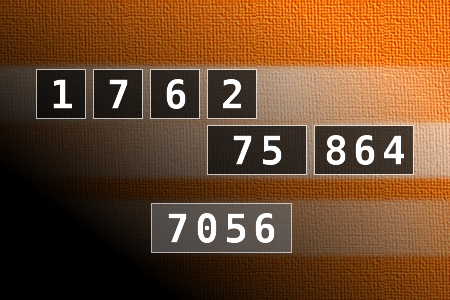
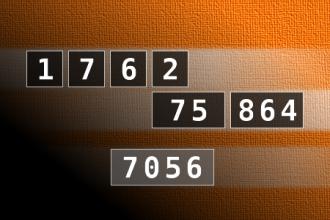
Calculate the number 7056
[6562] Calculate the number 7056 - NUMBERMANIA: Calculate the number 7056 using numbers [1, 7, 6, 2, 75, 864] and basic arithmetic operations (+, -, *, /). Each of the numbers can be used only once. - #brainteasers #math #numbermania - Correct Answers: 12 - The first user who solved this task is Nílton Corrêa de Sousa
BRAIN TEASERS
enter your answer and press button OK

Calculate the number 7056

NUMBERMANIA: Calculate the number 7056 using numbers [1, 7, 6, 2, 75, 864] and basic arithmetic operations (+, -, *, /). Each of the numbers can be used only once.
Correct answers: 12
The first user who solved this task is Nílton Corrêa de Sousa.
#brainteasers #math #numbermania
Register with your Google Account and start collecting points.
Check your ranking on list.

Upon reaching 65, old Tom deci...

Upon reaching 65, old Tom decided to retire. His wife suggested he go and do something to occupy his time, like join a club or get a hobby
Old Tom obliged and went out for a couple of hours. When he got home his wife asked about his day and he replied, "Oh, I joined a parachute club."
"What? Are you nuts? You're 65 years old and you're going to start jumping out of airplanes?"
"Yeah, look I even got a membership card."
"Old man, you need glasses! This is a membership in a Prostitute Club, not a Parachute Club!"
"Oh, great! Now what am I going to do? I signed up for 5 jumps a week!"
Jokes of the day - Daily updated jokes. New jokes every day.
Follow Brain Teasers on social networks

Brain Teasers

puzzles, riddles, mathematical problems, mastermind, cinemania...

Neptune

In 1989, the first complete ring around Neptune was discovered in photographs transmitted by Voyager 2 to the Jet Propulsion Laboratory in the U.S. Dusty debris was seen to form a tenuous but complete ring about 17,000 miles above Neptune's clouds. The material in the ring appeared be distributed uniformly through the dark circle, though whether fine or large particles was undetermined. The ring lies just outside the orbit of one of the planet's small moons, designated then as 1989 N3, also newly discovered by Voyager 2. Only arcs - fragments of rings around Neptune, had previously viewed from Earth-based observations, which were also shown as arcs in photographs taken by Voyager 2 eleven days earlier.«[Image: Part of a 591-second exposure of the rings of Neptune taken by Voyager 2 on 26 Aug 1989. Two main rings and and a fainter inner ring are visible. Neptune itself is to the right of this portion of the image, but has been cropped as it is greatly overexposed. A second exposure by Voyager (not included here) shows the rings circling around the other side of Neptune.]
This site uses cookies to store information on your computer. Some are essential to help the site properly. Others give us insight into how the site is used and help us to optimize the user experience. See our privacy policy.