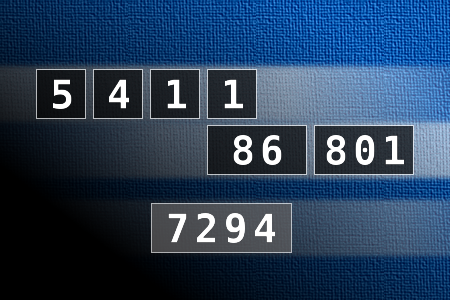
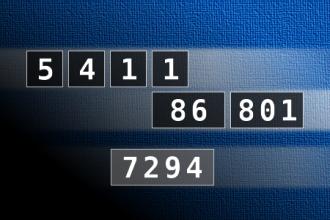
Calculate the number 7294
[6757] Calculate the number 7294 - NUMBERMANIA: Calculate the number 7294 using numbers [5, 4, 1, 1, 86, 801] and basic arithmetic operations (+, -, *, /). Each of the numbers can be used only once. - #brainteasers #math #numbermania - Correct Answers: 13 - The first user who solved this task is Nasrin 24 T
BRAIN TEASERS
enter your answer and press button OK

Calculate the number 7294

NUMBERMANIA: Calculate the number 7294 using numbers [5, 4, 1, 1, 86, 801] and basic arithmetic operations (+, -, *, /). Each of the numbers can be used only once.
Correct answers: 13
The first user who solved this task is Nasrin 24 T.
#brainteasers #math #numbermania
Register with your Google Account and start collecting points.
Check your ranking on list.

There was a blonde who was sic...

There was a blonde who was sick of all the blonde jokes. One day, she decided to get a make over, so she cut and dyed her hair. She went driving down a country road and came across a herd of sheep. She stopped and called the sheep herder over."Tell you what. I have a proposition for you," said the woman.
"If I can guess the exact number of sheep in your flock, can I take one home?"
"Sure," said the sheep herder. So, she sat up and looked at the herd for a second and then replied "382".
"Wow!" said the herder.
"That is exactly right. Go ahead and pick out the sheep you want to take home." So the woman went and picked one out and put it in her car.
Then, the herder said, "Okay, now I have a proposition for you".
"What is it?" queried the woman.
"If I can guess the real color of your hair, can I have my dog back?"
Jokes of the day - Daily updated jokes. New jokes every day.
Follow Brain Teasers on social networks

Brain Teasers

puzzles, riddles, mathematical problems, mastermind, cinemania...

Gerhard Herzberg

Born 25 Dec 1904; died 3 Mar 1999 at age 94.German-Canadian physicist who was awarded the 1971 Nobel Prize for Chemistry "for his contributions to the knowledge of electronic structure and geometry of molecules, particularly free radicals." He published his first work in molecular spectroscopy at the end of the 1920's. His measurement of how molecules absorb ultraviolet and infrared energy yield information on energy states in molecules, leading to knowledge of their size, shape and other properties. For example, he showed that radicals can drastically change their shape with increasing energy, such as methylene which is linear in its ground state but bent in higher energy states. He also applied spectroscopy in astronomy, identifying molecules in space, planetary atmospheres and comets.«
This site uses cookies to store information on your computer. Some are essential to help the site properly. Others give us insight into how the site is used and help us to optimize the user experience. See our privacy policy.