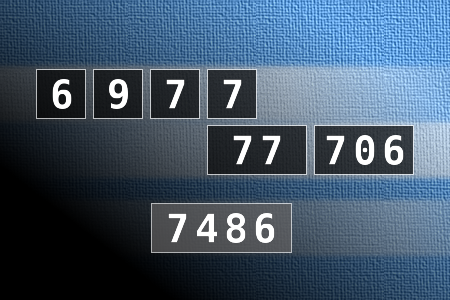
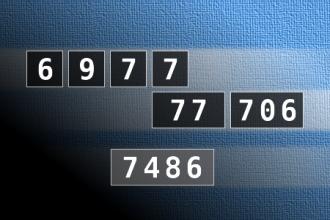
Calculate the number 7486
[3070] Calculate the number 7486 - NUMBERMANIA: Calculate the number 7486 using numbers [6, 9, 7, 7, 77, 706] and basic arithmetic operations (+, -, *, /). Each of the numbers can be used only once. - #brainteasers #math #numbermania - Correct Answers: 28 - The first user who solved this task is Sanja Šabović
BRAIN TEASERS
enter your answer and press button OK

Calculate the number 7486

NUMBERMANIA: Calculate the number 7486 using numbers [6, 9, 7, 7, 77, 706] and basic arithmetic operations (+, -, *, /). Each of the numbers can be used only once.
Correct answers: 28
The first user who solved this task is Sanja Šabović.
#brainteasers #math #numbermania
Register with your Google Account and start collecting points.
Check your ranking on list.

Two hikers were walking throug...

Two hikers were walking through central Pennsylvania when they came upon a 6 foot wide hole in the ground. They figured it must be the opening for a vertical air shaft from an old abandoned coal mine. Curious as to the depth of the hole, the first hiker picked up a nearby rock and tossed it into the opening. They listened... and heard nothing.
The second hiker picked up an even larger rock and tossed it into the opening. They listened... and still heard nothing. Then they both picked up an old railroad tie, dragged it to the edge of the shaft, and hurled it down. Seconds later a dog came running up between the two men and jumped straight into the hole. Bewildered, the two men just looked at each other, trying to figure out why a dog would do such a thing.
Soon a young boy ambled onto the scene and asked if either man had seen a dog around here. The hikers told him about the dog that had just jumped into the hole.
The young boy laughed and said, "That couldn't be my dog. My dog was tied to a railroad tie!"
Jokes of the day - Daily updated jokes. New jokes every day.
Follow Brain Teasers on social networks

Brain Teasers

puzzles, riddles, mathematical problems, mastermind, cinemania...

Wilhelm Roux

Born 9 Jun 1850; died 15 Sep 1924 at age 74. German zoologist who was a founder of experimental embryology, by which he studied how organs and tissues are assigned their structural form and functions at the time of fertilization. In the 1880s, he experimented with frog eggs. He thought that mitotic cell division of the fertilized egg is the mechanism by which future parts of a developing organism are determined. He destroyed one of the two initial subdivisions (blastomeres) of a fertilized frog egg, obtaining half an embryo from the remaining blastomere. It seemed to him that determination of future parts and functions had already occurred in the two-cell stage and that each of the two blastomeres had already received the determinants necessary to form half the embryo. His theory was later negated by Hans Driesch.
This site uses cookies to store information on your computer. Some are essential to help the site properly. Others give us insight into how the site is used and help us to optimize the user experience. See our privacy policy.