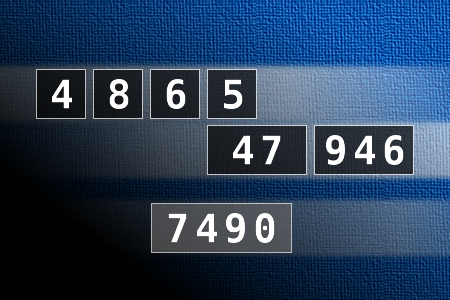
Calculate the number 7490
[2867] Calculate the number 7490 - NUMBERMANIA: Calculate the number 7490 using numbers [4, 8, 6, 5, 47, 946] and basic arithmetic operations (+, -, *, /). Each of the numbers can be used only once. - #brainteasers #math #numbermania - Correct Answers: 31 - The first user who solved this task is Adman72 Rocks
BRAIN TEASERS
enter your answer and press button OK

Calculate the number 7490

NUMBERMANIA: Calculate the number 7490 using numbers [4, 8, 6, 5, 47, 946] and basic arithmetic operations (+, -, *, /). Each of the numbers can be used only once.
Correct answers: 31
The first user who solved this task is Adman72 Rocks.
#brainteasers #math #numbermania
Register with your Google Account and start collecting points.
Check your ranking on list.

Lumberyard

Jon's working at the lumberyard, pushing a tree through the buzz saw, and accidentally shears off all ten of his fingers. He goes to the emergency room.
The doctor says, "Yuck! Well, give me the fingers, and I'll see what I can do."
Jon says, "I haven't got the fingers."
The doctor says, "What do you mean, you haven't got the fingers? It's 1999. We've got microsurgery and all kinds of incredible techniques. I could have put them back on and made you like new. Why didn't you bring the fingers?"
Jon says, "Well, sh*t, Doc, I couldn't pick 'em up."    

Jokes of the day - Daily updated jokes. New jokes every day.
Follow Brain Teasers on social networks

Brain Teasers

puzzles, riddles, mathematical problems, mastermind, cinemania...

Salomon Bochner

Died 2 May 1982 at age 82 (born 20 Aug 1899). Salomon Chaim Bochner was a Galician-American mathematician and educator who is remembered for his Bochner theorem of positive-definite functions and the Bochner integral. In the later development of abstract Fourier analysis, the Bochner theorem was basic to the theory of distributions. He started his academic career in Germany. In 1933, as a Jew, with the rise of the Nazism, he fled to the U.S., where he joined the faculty at Princeton. In addition to his life-long interest in harmonic analysis, in his prolific writings, Bochner also contributed significantly to complex analysis, differential geometry, probability and other pioneering work in pure mathematics. In his later years, he turned almost exclusively to the history and philosophy of science. His best-known book, The Role of Mathematics in the Rise of Science (1966), was translated into many languages.«
This site uses cookies to store information on your computer. Some are essential to help the site properly. Others give us insight into how the site is used and help us to optimize the user experience. See our privacy policy.