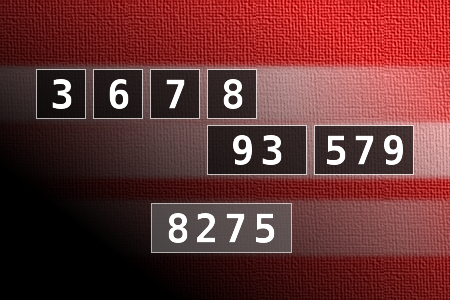
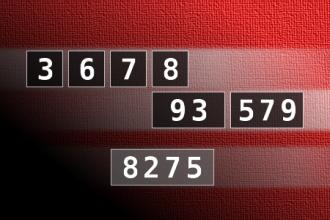
Calculate the number 8275
[7123] Calculate the number 8275 - NUMBERMANIA: Calculate the number 8275 using numbers [3, 6, 7, 8, 93, 579] and basic arithmetic operations (+, -, *, /). Each of the numbers can be used only once. - #brainteasers #math #numbermania - Correct Answers: 2
BRAIN TEASERS
enter your answer and press button OK

Calculate the number 8275

NUMBERMANIA: Calculate the number 8275 using numbers [3, 6, 7, 8, 93, 579] and basic arithmetic operations (+, -, *, /). Each of the numbers can be used only once.
Correct answers: 2
#brainteasers #math #numbermania
Register with your Google Account and start collecting points.
Check your ranking on list.

After a very busy day, a commu...

After a very busy day, a commuter settled down in her seat and closed her eyes as the train departed London for Liverpool. As the train rolled out of the station, the guy sitting next to her pulled out his mobile phone and started talking in a loud voice: "Hi sweetheart, it's Eric, I'm on the train, I know it's the six thirty and not the four thirty but I had a long meeting, no, honey, not with that floozie from the accounts office, with the boss. No sweetheart, you're the only one in my life, yes, I'm sure, cross my heart."
Fifteen minutes later, he was still talking loudly, when the young woman sitting next to him, who was obviously angered by his continuous rabble, yelled at the top of her voice: "Hey, Eric, turn that stupid phone off and get yourself back into bed!"
Jokes of the day - Daily updated jokes. New jokes every day.
Follow Brain Teasers on social networks

Brain Teasers

puzzles, riddles, mathematical problems, mastermind, cinemania...

Deuterium

In 1933, Ernest Rutherford suggested the names diplogen for the newly discovered heavy hydrogen isotope and diplon for its nucleus. He presented these ideas in the Discussion on Heavy Hydrogen at the Royal Society. For ordinary hydrogen, the lightest of the atoms, having a nuclues of a sole proton, he coined a related name: haplogen. (Greek: haploos, single; diploos, double.) In 1931, Harold Urey had discovered small quantities of atoms of heavy hydrogen wherever ordinary hydrogen occurred. The mass of its nucleus was double that of ordinary hydrogen. This hydrogen-2 is now called deuterium, as named by Urey (Greek: deuteros, second). Its nucleus, named a deuteron, has a neutron in addition to a proton.[ref: Proc. Roy. Soc. A, vol. 144 (1934)]
This site uses cookies to store information on your computer. Some are essential to help the site properly. Others give us insight into how the site is used and help us to optimize the user experience. See our privacy policy.