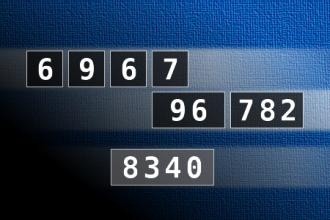
Calculate the number 8340
[7893] Calculate the number 8340 - NUMBERMANIA: Calculate the number 8340 using numbers [6, 9, 6, 7, 96, 782] and basic arithmetic operations (+, -, *, /). Each of the numbers can be used only once. - #brainteasers #math #numbermania - Correct Answers: 2
BRAIN TEASERS
enter your answer and press button OK

Calculate the number 8340

NUMBERMANIA: Calculate the number 8340 using numbers [6, 9, 6, 7, 96, 782] and basic arithmetic operations (+, -, *, /). Each of the numbers can be used only once.
Correct answers: 2
#brainteasers #math #numbermania
Register with your Google Account and start collecting points.
Check your ranking on list.

National Geographic

Ole and Lena are 69-ing when Ole says, "Lena, did you know there are 117,000 musk ox in Alaska?"

Lena says, "No, I didn't."

Ole says, "And Lena, did you know there are 482,000 grizzly bears living in Alaska?"

Lena says, "No, I didn't. Gee, you're smart."

Ole says, "And Lena, did you know there are more than 2 million caribou living in Alaska?"

"No," says Lena, wondering how this conversation came about in the middle of their sex play.

"How did you get so smart?"

Ole says, "Remember last night when we ran out of toilet paper and had to use the pages out of magazines?"

"Yes, I remember," says Lena.

"Well, you still have page 63 of National Geographic stuck to your ass."

Jokes of the day - Daily updated jokes. New jokes every day.
Follow Brain Teasers on social networks

Brain Teasers

puzzles, riddles, mathematical problems, mastermind, cinemania...

Player piano

In 1881, a patent was issued for his invention of a piano player to John McTammany, Jr., of Cambridge, Mass. He had earlier filed a caveat on 7 Sep 1876. His patent descibed his "mechanical mucical instrument" as a mechanism for automatic playing of organs using narrow sheets of perforated flexible paper which governed the notes to be played. The first completely automatic piano player to be manufactured in the U.S. was the Angelus made in Feb 1897, which was patented by its inventor, Edward H. Leveaux, in England on 27 Feb 1879, and who was issued a U.S. patent on 4 Oct 1881 for an "apparatus for storing and transmitting motive power."
This site uses cookies to store information on your computer. Some are essential to help the site properly. Others give us insight into how the site is used and help us to optimize the user experience. See our privacy policy.