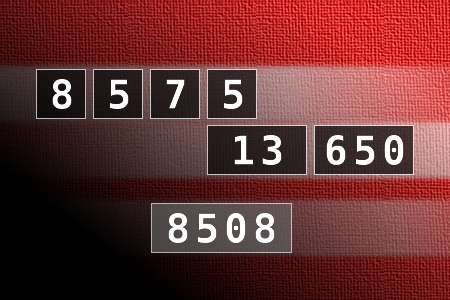
Calculate the number 8508
[8039] Calculate the number 8508 - NUMBERMANIA: Calculate the number 8508 using numbers [8, 5, 7, 5, 13, 650] and basic arithmetic operations (+, -, *, /). Each of the numbers can be used only once. - #brainteasers #math #numbermania - Correct Answers: 0
BRAIN TEASERS
enter your answer and press button OK

Calculate the number 8508

NUMBERMANIA: Calculate the number 8508 using numbers [8, 5, 7, 5, 13, 650] and basic arithmetic operations (+, -, *, /). Each of the numbers can be used only once.
Correct answers: 0
#brainteasers #math #numbermania
Register with your Google Account and start collecting points.
Check your ranking on list.

Never Trust a Street Gang in Heaven

One day St. Peter saw a street gang walking up to the Pearly Gates.
St. Peter ran to God and said, "God, there are some low-life street gang members at the Gates. What do I do?"
God relied, "Just do what you normally do with that type. Redirect them."
St. Peter went back to carry out the order, but he suddenly came running back and yelling, "God, God, they're gone! They're gone!"
"The street gang?"
"No, the Pearly Gates!"

Jokes of the day - Daily updated jokes. New jokes every day.
Follow Brain Teasers on social networks

Brain Teasers

puzzles, riddles, mathematical problems, mastermind, cinemania...

Francesco Maria Grimaldi

Born 2 Apr 1618; died 28 Dec 1663 at age 45.Italian physicist and mathematician who studied the diffraction of light. He observed the image on a screen in a darkened room of a tiny beam of sunlight after it passed pass through a fine screen (or a slit, edge of a screen, wire, hair, fabric or bird feather). The image had iridescent fringes, and deviated from a normal geometrical shadow. He coined the name diffraction for this change of trajectory of the light passing near opaque objects (though, more specifically, it may have been interferences with two close sources that he observed). This provided evidence for later physicists to support the wave theory of light. With Riccioli, he investigated the object in free fall (1640-50), and found that distance of fall was proportional to the square of the time taken.«
This site uses cookies to store information on your computer. Some are essential to help the site properly. Others give us insight into how the site is used and help us to optimize the user experience. See our privacy policy.