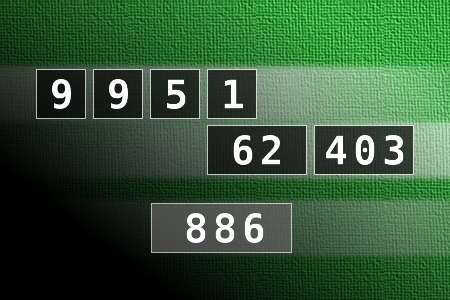
Calculate the number 886
[6079] Calculate the number 886 - NUMBERMANIA: Calculate the number 886 using numbers [9, 9, 5, 1, 62, 403] and basic arithmetic operations (+, -, *, /). Each of the numbers can be used only once. - #brainteasers #math #numbermania - Correct Answers: 9 - The first user who solved this task is Nílton Corrêa de Sousa
BRAIN TEASERS
enter your answer and press button OK

Calculate the number 886

NUMBERMANIA: Calculate the number 886 using numbers [9, 9, 5, 1, 62, 403] and basic arithmetic operations (+, -, *, /). Each of the numbers can be used only once.
Correct answers: 9
The first user who solved this task is Nílton Corrêa de Sousa.
#brainteasers #math #numbermania
Register with your Google Account and start collecting points.
Check your ranking on list.

Easy Computer Fix

I received this from a CEO that I worked with a few years back. He doesn't want to admit it but I think this is his true experience.
I was having trouble with my computer so I called Richard, the 11 year old next door whose bedroom looks like Mission Control, and asked him to come over.
Richard clicked a couple of buttons and solved the problem.
As he was walking away, I called after him, 'So, what was wrong?'
He replied, 'It was an ID ten T error.'
I didn't want to appear stupid, but nonetheless inquired, 'An ID ten T error? What's that? In case I need to fix it again.'
Richard grinned. 'Haven't you ever heard of an ID ten T error before?'
'No,' I replied.
'Write it down,' he said, 'and I think you'll figure it out.’
So I wrote down: I D 1 0 T
I used to like the little sh*t
Jokes of the day - Daily updated jokes. New jokes every day.
Follow Brain Teasers on social networks

Brain Teasers

puzzles, riddles, mathematical problems, mastermind, cinemania...

Sewing Machine

In 1790, Thomas Saint, a London cabinet maker, patented possibly the first sewing machine, fitted with an awl that makes a hole in leather and allows a needle to pass through it. This machine made a chain stitch with a tambour-type needle to produce a mechanical crochet or chain stitch. No evidence exists that Saint produced a single machine, and those who in the 1880's followed his patent specifications failed. An earlier English patent (24 Jun 1755) by German mechanic, Charles Weisenthal, had described a two-pointed needle for mechanical sewing, but there was no mention of a machine to go with it.Image: Wilcox-Gibbs sewing machine, c.1890.
This site uses cookies to store information on your computer. Some are essential to help the site properly. Others give us insight into how the site is used and help us to optimize the user experience. See our privacy policy.