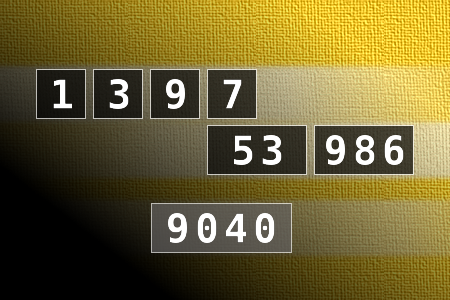

Calculate the number 9040
[7437] Calculate the number 9040 - NUMBERMANIA: Calculate the number 9040 using numbers [1, 3, 9, 7, 53, 986] and basic arithmetic operations (+, -, *, /). Each of the numbers can be used only once. - #brainteasers #math #numbermania - Correct Answers: 2
BRAIN TEASERS
enter your answer and press button OK

Calculate the number 9040

NUMBERMANIA: Calculate the number 9040 using numbers [1, 3, 9, 7, 53, 986] and basic arithmetic operations (+, -, *, /). Each of the numbers can be used only once.
Correct answers: 2
#brainteasers #math #numbermania
Register with your Google Account and start collecting points.
Check your ranking on list.

The golfer and the funeral

A golfer and his buddies were playing a big round of golf for $200.

At the eighteenth green the golfer had a ten foot putt to win the round, and the $200.

As he was lining up his putt, a funeral procession started to pass by.

The golfer set down his putter, took his hat off, placed it over his chest, and waited for the funeral procession to pass.

After it passed, he picked up his putter and returned to lining up his putt, and completed it, thus winning the game and the money.

Afterwards, one of his buddies said, "That was the most touching thing I have ever seen.

I can't believe you stopped playing, possibly losing your concentration, to pay your respects."

"Well," said the golfer, "we were married for 25 years."

Jokes of the day - Daily updated jokes. New jokes every day.
Follow Brain Teasers on social networks

Brain Teasers

puzzles, riddles, mathematical problems, mastermind, cinemania...

J.C. Arthur

Born 11 Jan 1850; died 30 Apr 1942 at age 92.Joseph Charles Arthur was an American botanist who discovered basic facts about the parasitic fungi known as 'rusts.' He was the first head of the Department of Botany and Plant Pathology at Purdue University. The plant rusts form one of the largest natural groups of plant parasitic fungi. They are of great scientific interest because of their close evolutionary relationships with their host plants, their complex life cycles, and their numerous biological adaptations that permit them to thrive on all the continents (except Antarctica) under great extremes of environments.
This site uses cookies to store information on your computer. Some are essential to help the site properly. Others give us insight into how the site is used and help us to optimize the user experience. See our privacy policy.