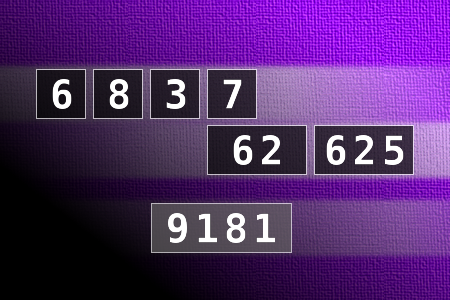
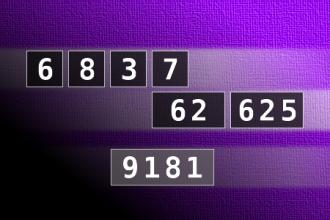
Calculate the number 9181
[8088] Calculate the number 9181 - NUMBERMANIA: Calculate the number 9181 using numbers [6, 8, 3, 7, 62, 625] and basic arithmetic operations (+, -, *, /). Each of the numbers can be used only once. - #brainteasers #math #numbermania - Correct Answers: 0
BRAIN TEASERS
enter your answer and press button OK

Calculate the number 9181

NUMBERMANIA: Calculate the number 9181 using numbers [6, 8, 3, 7, 62, 625] and basic arithmetic operations (+, -, *, /). Each of the numbers can be used only once.
Correct answers: 0
#brainteasers #math #numbermania
Register with your Google Account and start collecting points.
Check your ranking on list.

Embarrassing Situations!

A very shy guy goes into a bar and sees a beautiful woman sitting at the other end. After an hour of gathering up his courage he finally goes over to her and asks, tentatively, "Um, would you mind if I chatted with you for a while?" To which she responds by yelling, at the top of her lungs, "No, I won't sleep with you tonight!" By now, the entire bar is staring at them. Naturally, the guy is hopelessly and completely embarrassed and he slinks back to his table. After a few minutes, the woman walks over to him and apologizes. She smiles at him and says, "I'm sorry if I embarrassed you. You see, I'm a graduate student in psychology and I'm studying how people respond to embarrassing situations." To which he responds, at the top of his lungs, "What do you mean $200!"
Jokes of the day - Daily updated jokes. New jokes every day.
Follow Brain Teasers on social networks

Brain Teasers

puzzles, riddles, mathematical problems, mastermind, cinemania...

Howard Hathaway Aiken

Died 14 Mar 1973 at age 73 (born 9 Mar 1900).American mathematician who invented the Harvard Mark I, forerunner of the modern electronic digital computer. While a graduate student and instructor Harvard University, Aiken's research had led to a system of differential equations which could only be solved using numerical techniques, for which he began planning large computer. His idea was to use an adaptation of Hollerith's punched card machine. When eventually built, (1943) it weighed 35 tons, had 500 miles of wire and could compute to 23 significant figures. There were 72 storage registers and central units to perform multiplication and division. It was controlled by a sequence of instructions on punched paper tapes, and used punched cards to enter data and give output from the machine.
This site uses cookies to store information on your computer. Some are essential to help the site properly. Others give us insight into how the site is used and help us to optimize the user experience. See our privacy policy.