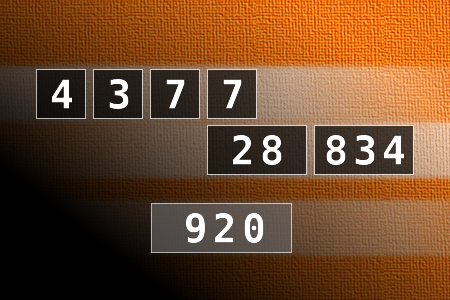
Calculate the number 920
[7591] Calculate the number 920 - NUMBERMANIA: Calculate the number 920 using numbers [4, 3, 7, 7, 28, 834] and basic arithmetic operations (+, -, *, /). Each of the numbers can be used only once. - #brainteasers #math #numbermania - Correct Answers: 1
BRAIN TEASERS
enter your answer and press button OK

Calculate the number 920

NUMBERMANIA: Calculate the number 920 using numbers [4, 3, 7, 7, 28, 834] and basic arithmetic operations (+, -, *, /). Each of the numbers can be used only once.
Correct answers: 1
#brainteasers #math #numbermania
Register with your Google Account and start collecting points.
Check your ranking on list.

Husband Worried Wife's Temper

A man goes to the doctor, worried about his wife's temper.
The doctor asks, “What’s the problem?”The man says, “Doctor, I don’t know what to do.
Every day my wife seems to lose her temper for no reason. It scares me.”
The doctor says, “I have a cure for that. When it seems that your wife is getting angry, just take a glass of water and start swishing it in your mouth.
Just swish and swish but don’t swallow it until she either leaves the room or calms down.”
Two weeks later, the man comes back to the doctor looking fresh and reborn.
The man says, “Doctor, that was a brilliant idea! Every time my wife started losing it, I swished with water.
I swished and swished, and she calmed right down! How does a glass of water do that?”
The doctor says, “The water itself does nothing. It’s keeping your mouth shut that does the trick.”

Jokes of the day - Daily updated jokes. New jokes every day.
Follow Brain Teasers on social networks

Brain Teasers

puzzles, riddles, mathematical problems, mastermind, cinemania...

Rayon

In 1902, the "making of cellulose esters" was jointly patented by William H. Walker, Arthur D. Little and Harry S. Mork of Massachusetts. (U.S. No. 709922). A month later, on 28 Oct 1902, they also patented artificial silk (No. 712,200). Viscose was an early name for the product. The term rayon was adopted by the textile industry in 1924 to replace "artificial silk" and similar names. It was said to derive from the French for "shine" - a reference to its silklike lustre. Unlike most man-made fibers, rayon is not synthetic. Made from wood pulp, a naturally-occurring, cellulose-based raw material, rayon's properties are more similar to those of natural cellulosic fibers, such as cotton or linen, than those of petroleum-based synthetic fibers such as nylon.
This site uses cookies to store information on your computer. Some are essential to help the site properly. Others give us insight into how the site is used and help us to optimize the user experience. See our privacy policy.