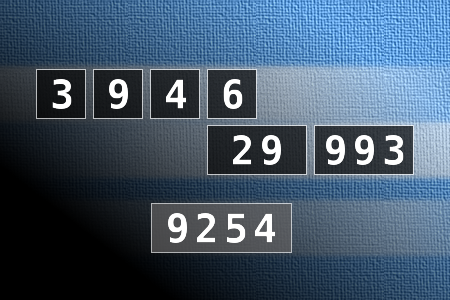
Calculate the number 9254
[3669] Calculate the number 9254 - NUMBERMANIA: Calculate the number 9254 using numbers [3, 9, 4, 6, 29, 993] and basic arithmetic operations (+, -, *, /). Each of the numbers can be used only once. - #brainteasers #math #numbermania - Correct Answers: 25 - The first user who solved this task is Fazil Hashim
BRAIN TEASERS
enter your answer and press button OK

Calculate the number 9254

NUMBERMANIA: Calculate the number 9254 using numbers [3, 9, 4, 6, 29, 993] and basic arithmetic operations (+, -, *, /). Each of the numbers can be used only once.
Correct answers: 25
The first user who solved this task is Fazil Hashim.
#brainteasers #math #numbermania
Register with your Google Account and start collecting points.
Check your ranking on list.

Catsup

Little Johnny's mother was trying hard to get the catsup to come out of the bottle. During her struggle the phone rang so she asked four-year old Johnny to answer the phone.
Little Johnny ran out into the living room and answered the phone. "Mommy, It's the minister," he said to his mother.
From the kitchen Johnny's mom said, "Tell him I'll call him back."
Little Johnny spoke into the phone saying, "Mommy can't come to the phone to talk to you right now. She's hitting the bottle."      

Jokes of the day - Daily updated jokes. New jokes every day.
Follow Brain Teasers on social networks

Brain Teasers

puzzles, riddles, mathematical problems, mastermind, cinemania...

Jean-Robert Argand

Born 18 Jul 1768; died 13 Aug 1822 at age 54.Swiss accountant and mathematician who was one of the earliest to use complex numbers, which he applied to show that all algebraic equations have roots. His name is associated with the Argand diagram, a geometrical representation of complex numbers as points in a Cartesian plane, with the real portion of the number on the x axis and the imaginary part on the y axis. He self-published this concept in an anonymous monograph (1806). Though talented in mathematics, he remained an amateur; his livelihood was asan accountant and bookkeeper. Although Argand's name became associated with this idea, the geometrical interpretation of complex numbers appeared earliest in work by Caspar Wessel (1787), first presented on 10 Mar 1797 to a the Royal Danish Academy of Sciences and published in 1799.«
This site uses cookies to store information on your computer. Some are essential to help the site properly. Others give us insight into how the site is used and help us to optimize the user experience. See our privacy policy.