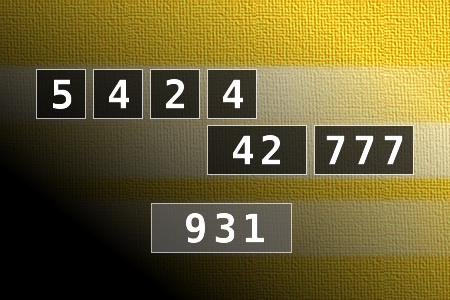
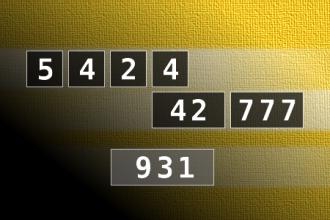
Calculate the number 931
[6567] Calculate the number 931 - NUMBERMANIA: Calculate the number 931 using numbers [5, 4, 2, 4, 42, 777] and basic arithmetic operations (+, -, *, /). Each of the numbers can be used only once. - #brainteasers #math #numbermania - Correct Answers: 11 - The first user who solved this task is Nasrin 24 T
BRAIN TEASERS
enter your answer and press button OK

Calculate the number 931

NUMBERMANIA: Calculate the number 931 using numbers [5, 4, 2, 4, 42, 777] and basic arithmetic operations (+, -, *, /). Each of the numbers can be used only once.
Correct answers: 11
The first user who solved this task is Nasrin 24 T.
#brainteasers #math #numbermania
Register with your Google Account and start collecting points.
Check your ranking on list.

Lengthy sermons...

A pastor, known for his lengthy sermons, noticed a man get up and leave during the middle of his message. The man returned just before the conclusion of the service. Afterwards the pastor asked the man where he had gone.

"I went to get a haircut," was the reply.

"But," said the pastor, "why didn't you do that before the service?"

"Because," the gentleman said, "I didn't need one then."

Jokes of the day - Daily updated jokes. New jokes every day.
Follow Brain Teasers on social networks

Brain Teasers

puzzles, riddles, mathematical problems, mastermind, cinemania...

Ernst Florens Friedrich Chladni

Died 3 Apr 1827 at age 70 (born 30 Nov 1756).German physicist who is known as the “father of acoustics”for his mathematical investigations of sound waves. Chladni figures, seen when thin plates covered in sand at set in vibration, are complex patterns of vibration with nodal lines that remain stationary and retain sand. He demonstrated these to an audience of scientists in Paris in 1809. He measured the speed of sound in various gases by determining the pitch of the note of an organ pipe filled with different gases. To determine the speed of sound in solids, Chladni used analysis of the nodal pattern in standing-wave vibrations in long rods. He performed on the euphonium, an instrument he invented, made of glass and steel bars vibrated by rubbing with a moistened finger. He also investigated meteorites.
This site uses cookies to store information on your computer. Some are essential to help the site properly. Others give us insight into how the site is used and help us to optimize the user experience. See our privacy policy.