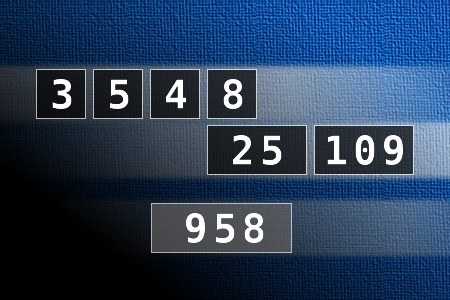
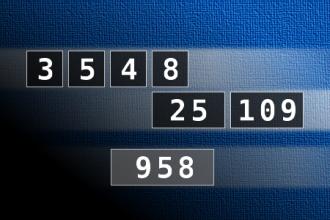
Calculate the number 958
[6695] Calculate the number 958 - NUMBERMANIA: Calculate the number 958 using numbers [3, 5, 4, 8, 25, 109] and basic arithmetic operations (+, -, *, /). Each of the numbers can be used only once. - #brainteasers #math #numbermania - Correct Answers: 8 - The first user who solved this task is Nílton Corrêa de Sousa
BRAIN TEASERS
enter your answer and press button OK

Calculate the number 958

NUMBERMANIA: Calculate the number 958 using numbers [3, 5, 4, 8, 25, 109] and basic arithmetic operations (+, -, *, /). Each of the numbers can be used only once.
Correct answers: 8
The first user who solved this task is Nílton Corrêa de Sousa.
#brainteasers #math #numbermania
Register with your Google Account and start collecting points.
Check your ranking on list.

Apples

The children were lined up in the cafeteria of a Catholic elementary school for lunch. At the head of the table was a large pile of apples. The nun made a note, and posted on the apple tray:
"Take only ONE. God is watching."
Moving further along the lunch line, at the other end of the table was a large pile of chocolate chip cookies.
A child had written a note, "Take all you want. God is watching the apples.    

Jokes of the day - Daily updated jokes. New jokes every day.
Follow Brain Teasers on social networks

Brain Teasers

puzzles, riddles, mathematical problems, mastermind, cinemania...

Gerard Henri de Vaucouleurs

Born 25 Apr 1918; died 7 Oct 1995 at age 77.French-born U.S. astronomer whose pioneering studies of distant galaxies contributed to knowledge of the age and large-scale structure of the universe. He produced three Reference Catalogues of bright galaxies (1964, 1976, 1991). Each was a homogenization of data from widely different sources, so that the catalogues would not be merely finding lists or data collection lists, but astrophysically useful databases. Using data in the Reference Catalogues, he was able to develop new distance indicators and refine others. His unique philosophy on distance matters was "spreading the risks," that is, applying as many different and independent techniques as possible to check for scale and zero-point errors.
This site uses cookies to store information on your computer. Some are essential to help the site properly. Others give us insight into how the site is used and help us to optimize the user experience. See our privacy policy.