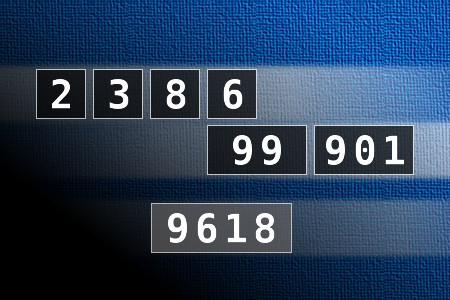
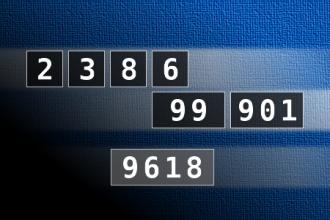
Calculate the number 9618
[8000] Calculate the number 9618 - NUMBERMANIA: Calculate the number 9618 using numbers [2, 3, 8, 6, 99, 901] and basic arithmetic operations (+, -, *, /). Each of the numbers can be used only once. - #brainteasers #math #numbermania - Correct Answers: 0
BRAIN TEASERS
enter your answer and press button OK

Calculate the number 9618

NUMBERMANIA: Calculate the number 9618 using numbers [2, 3, 8, 6, 99, 901] and basic arithmetic operations (+, -, *, /). Each of the numbers can be used only once.
Correct answers: 0
#brainteasers #math #numbermania
Register with your Google Account and start collecting points.
Check your ranking on list.

How many did you catch...

A kind-hearted fellow was walking through Central Park in New York and was astonished to see an old man, fishing rod in hand, fishing over a beautiful bed of lillies.

"Tch Tch!" said the passerby to himself. "What a sad sight. That poor old man is fishing over a bed of flowers. I'll see if I can help."

So the kind fellow walked up to the old man and asked, "What are you doing, my friend?"

"Fishin', sir."

"Fishin', eh. Well how would you like to come have a drink with me?"

The old man stood up, put his rod away and followed the kind stranger to the corner bar. He ordered a large glass of beer and a fine cigar.

His host, the kind fellow, felt good about helping the old man, and he asked, "Tell me, old friend, how many did you catch this morning?"

The old fellow took a long drag on the cigar, blew a careful smoke ring and replied, "You are the sixth today, sir!"

Jokes of the day - Daily updated jokes. New jokes every day.
Follow Brain Teasers on social networks

Brain Teasers

puzzles, riddles, mathematical problems, mastermind, cinemania...

John H. Van Vleck

Died 27 Oct 1980 at age 81 (born 13 Mar 1899).John Hasbrouck Van Vleck was an American physicist and mathematician who pioneered in the modern quantum mechanical theory of magnetism, and shared the 1977 Nobel Prize for Physics (with Philip W. Anderson and Sir Nevill F. Mott) for his work on the behaviour of electrons in magnetic, noncrystalline solid materials. In about 1930, he introduced the contribution of the second-order Zeeman effect into the theory of the paramagnetic susceptibility for the ions of the elements samarium and europium, thus bringing calculations into agreement with experimental results. Hans Bethe's theoretical work (c.1929), was extended by Van Vleck to develop the ligand, or crystal, field theory of molecular bonding. He also studied the theory for the nature of the chemical bond, especially as related to its magnetic properties, and contributed to theory of the spectra of free molecules.«
This site uses cookies to store information on your computer. Some are essential to help the site properly. Others give us insight into how the site is used and help us to optimize the user experience. See our privacy policy.