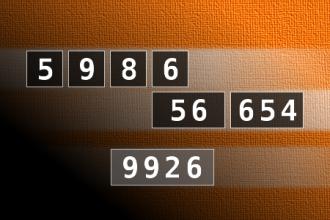
Calculate the number 9926
[8158] Calculate the number 9926 - NUMBERMANIA: Calculate the number 9926 using numbers [5, 9, 8, 6, 56, 654] and basic arithmetic operations (+, -, *, /). Each of the numbers can be used only once. - #brainteasers #math #numbermania - Correct Answers: 0
BRAIN TEASERS
enter your answer and press button OK

Calculate the number 9926

NUMBERMANIA: Calculate the number 9926 using numbers [5, 9, 8, 6, 56, 654] and basic arithmetic operations (+, -, *, /). Each of the numbers can be used only once.
Correct answers: 0
#brainteasers #math #numbermania
Register with your Google Account and start collecting points.
Check your ranking on list.

Spaghetti

A wealthy man was having an affair with an Italian woman for several months. One night, during one of their rendezvous, she confided in him that she was pregnant. Not wanting to ruin his reputation or his marriage, he paid her a large sum of money if she would go to Italy to secretly have the child. If she stayed in Italy to raise the child, he would also provide child support until the child turned 18. She agreed, but asked how he would know when the baby was born. To keep it discreet, he told her simply to mail him a post card, and write "Spaghetti" on the back. He would then arrange for child support payments to begin.
One day, about 9 months later, he came home to his confused wife. "Honey," she said, "you received a very strange post card today."
"Oh, just give it to me and I'll explain it" he said.
The wife obeyed, and watched as her husband read the card, turned white, and fainted.
On the card was written: "Spaghetti, Spaghetti, Spaghetti. Two with meatballs, one without."  

Jokes of the day - Daily updated jokes. New jokes every day.
Follow Brain Teasers on social networks

Brain Teasers

puzzles, riddles, mathematical problems, mastermind, cinemania...

Peter Waage

Died 13 Jan 1900 at age 66 (born 29 Jun 1833).Norwegian chemist who, with his brother-in-law Cato Guldberg published the mass action law in 1864. The law states that the rate of a chemical change depends on the concentrations of the reactants. Thus for a reaction: A + B —> C the rate of reaction is proportional to [A][B], where [A] and [B] are concentrations. They also investigated the effects of temperature. Their work did not gain full credit at the time, partly due to their first publishing the law in Norwegian. Even when published in French (1867) the law received little attention. Waage later turned to practical problems relating to nutrition and public health, and he also engaged in social and religious work. (The law was rediscovered by William Esson and Vernon Harcourt.)
This site uses cookies to store information on your computer. Some are essential to help the site properly. Others give us insight into how the site is used and help us to optimize the user experience. See our privacy policy.