CINEMANIA: Guess the movie title
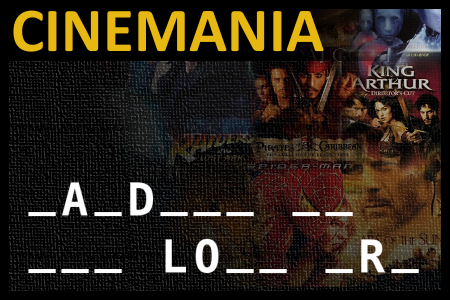
[1019] CINEMANIA: Guess the movie title - Archeologist and adventurer Indiana Jones is hired by the US government to find the Ark of the Covenant before the Nazis. Film was made in 1981. - #brainteasers #movie #film #cinemania - Correct Answers: 64 - The first user who solved this task is Djordje Timotijevic
BRAIN TEASERS
enter your answer and press button OK

CINEMANIA: Guess the movie title

Archeologist and adventurer Indiana Jones is hired by the US government to find the Ark of the Covenant before the Nazis. Film was made in 1981.
Correct answers: 64
The first user who solved this task is Djordje Timotijevic.
#brainteasers #movie #film #cinemania
Register with your Google Account and start collecting points.
Check your ranking on list.

Spanish Fly

A guy offers to buy a drink for an attractive young woman seated at a bar.
She gives him the green light, so he goes to the end of the bar and whispers to the bartender to make up a Martini for her and to put some Spanish-fly in the drink.
The bartender whispers back to say he's all out of Spanish-fly and all he has left is Jewish-fly.
Shrugging his shoulders, the guy says, OK, put some of that in her drink.
As she sips on the drink, she gets more and more cozy, really warming up to the guy.
Finally, she finishes the drink, leans over and whispers in his ear. 'Let's go shopping.'

Jokes of the day - Daily updated jokes. New jokes every day.
Follow Brain Teasers on social networks

Brain Teasers

puzzles, riddles, mathematical problems, mastermind, cinemania...

Rocket reaches 100 mi altitude

In 1946, for the first time an altitude of 100 mi (167 km) was reached by a test rocket. It was a V-2 rocket (No. 9), fueled with alcohol and liquid oxygen launched at White Sands, NM. This test had the first separation of nose cone. During World War II, the nose cone held a German warhead containing almost a ton of explosives. At White Sands, the Army invited government agencies and universities to use the nose cone's 20 cubic feet of space for scientific research, up to 2,000 pounds of scientific equipment, such as cameras, sensors, and on-board experiments, were carried aloft on each flight.
This site uses cookies to store information on your computer. Some are essential to help the site properly. Others give us insight into how the site is used and help us to optimize the user experience. See our privacy policy.