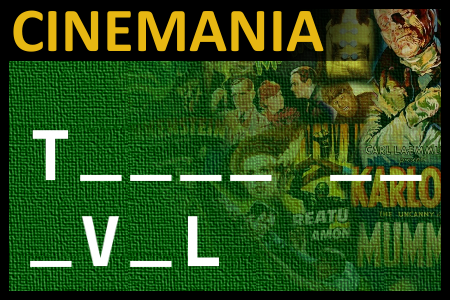
CINEMANIA: Guess the movie title
[1621] CINEMANIA: Guess the movie title - Film was made in 1958. - #brainteasers #movie #film #cinemania - Correct Answers: 49 - The first user who solved this task is Djordje Timotijevic
BRAIN TEASERS
enter your answer and press button OK

CINEMANIA: Guess the movie title

Film was made in 1958.
Correct answers: 49
The first user who solved this task is Djordje Timotijevic.
#brainteasers #movie #film #cinemania
Register with your Google Account and start collecting points.
Check your ranking on list.

A doctor, a lawyer, a little boy and a priest...

A doctor, a lawyer, a little boy and a priest were out for a Sunday afternoon flight on a small private plane. Suddenly, the plane developed engine trouble.

In spite of the best efforts of the pilot, the plane started to go down. Finally, the pilot grabbed a parachute, yelled to the passengers that they had better jump, and bailed out.

Unfortunately, there were only three parachutes remaining. The doctor grabbed one and said "I'm a doctor, I save lives, so I must live," and jumped out.

The lawyer then said, "I'm a lawyer and lawyers are the smartest people in the world. I deserve to live."

He also grabbed a parachute and jumped.

The priest looked at the little boy and said, "My son, I've lived a long and full life. You are young and have your whole life ahead of you. Take the last parachute and live in peace."

The little boy handed the parachute back to the priest and said, "Not to worry, Father. The 'smartest man in the world' just took off with my back pack."

Jokes of the day - Daily updated jokes. New jokes every day.
Follow Brain Teasers on social networks

Brain Teasers

puzzles, riddles, mathematical problems, mastermind, cinemania...

Peter C. Doherty

Born 15 Oct 1940.Australian immunologist and pathologist who, with Swiss-born Rolf Zinkernagel, shared the Nobel Prize for Physiology or Medicine in 1996 for their project at the John Curtin School of Medical Research in Canberra, Australia (1973-5). Using mice, they studied how the immune system's T-lymphocytes, recognize virus-infected cells from healthy cells. The "killer T-cells," in a test tube killed cells infected by a virus, and worked only against a specific virus in a specific mouse and could not be transferred to a different animal. Such discoveries have a wide impact on the study of diseases such as rheumatic conditions, multiple sclerosis and diabetes. He was the seventh Australian Nobelist, and the first who was a veterinarian.
This site uses cookies to store information on your computer. Some are essential to help the site properly. Others give us insight into how the site is used and help us to optimize the user experience. See our privacy policy.