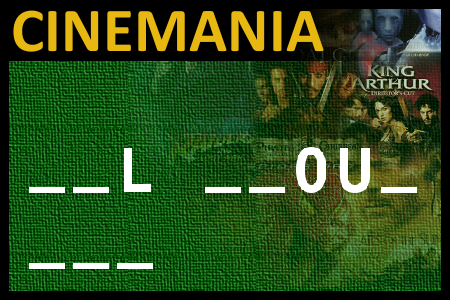
CINEMANIA: Guess the movie title
[177] CINEMANIA: Guess the movie title - An ingenue insinuates herself in to the company of an established but aging stage actress and her circle of theater friends. Film was made in 1950. - #brainteasers #movie #film #cinemania - Correct Answers: 59 - The first user who solved this task is Djordje Timotijevic
BRAIN TEASERS
enter your answer and press button OK

CINEMANIA: Guess the movie title

An ingenue insinuates herself in to the company of an established but aging stage actress and her circle of theater friends. Film was made in 1950.
Correct answers: 59
The first user who solved this task is Djordje Timotijevic.
#brainteasers #movie #film #cinemania
Register with your Google Account and start collecting points.
Check your ranking on list.

A man placed some flowers o...

A man placed some flowers on the grave of his dearly departed mother and started back toward his car when his attention was diverted to another man kneeling at a grave. The man seemed to be praying with profound intensity and kept repeating, "Why did you have to die? Why did you have to die?" The first man approached him and said, "Sir, I don't wish to interfere with your private grief, but this demonstration of pain is more than I've ever seen before. For whom do you mourn so deeply? A child? A parent?" The mourner took a moment to collect himself, then replied, "My wife's first husband."

Jokes of the day - Daily updated jokes. New jokes every day.
Follow Brain Teasers on social networks

Brain Teasers

puzzles, riddles, mathematical problems, mastermind, cinemania...

Comet

In 1864, Giovanni Batista Donati (1827-73) made the first spectroscopic observations of a comet tail (from the small comet, Tempel, 1864 II). At a distance from the Sun the spectrum of a comet is identical to that of the Sun, and its visibility is due only to reflected sunlight. Donati showed that comet tail formed close to the Sun contains luminous gas. In the spectrum of light from the comet tail, Donati saw three absorption lines bands superimposed on a continuous spectrum, which he named alpha, beta and gamma, and are now known as the Swan bands. These bands were also seen in a comet tail viewed by Pietro Secchi in 1866. Sir William Huggins (1868) identified that these were due to the presence of carbon (molecular carbon, C2).[Image: Comet tail of Comet West 1976 VI, computer generated false colour image.]
This site uses cookies to store information on your computer. Some are essential to help the site properly. Others give us insight into how the site is used and help us to optimize the user experience. See our privacy policy.