CINEMANIA: Guess the movie title
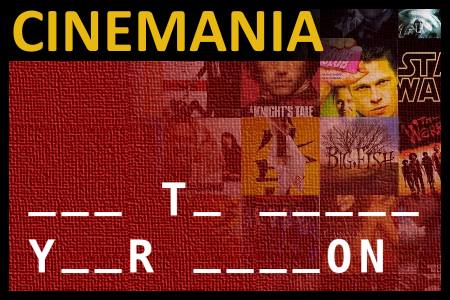
[660] CINEMANIA: Guess the movie title - A hapless young Viking who aspires to hunt dragons becomes the unlikely friend of a young dragon himself, and learns there may be more to the creatures than he assumed. Film was made in 2010. - #brainteasers #movie #film #cinemania - Correct Answers: 67 - The first user who solved this task is Sanja Šabović
BRAIN TEASERS
enter your answer and press button OK

CINEMANIA: Guess the movie title

A hapless young Viking who aspires to hunt dragons becomes the unlikely friend of a young dragon himself, and learns there may be more to the creatures than he assumed. Film was made in 2010.
Correct answers: 67
The first user who solved this task is Sanja Šabović.
#brainteasers #movie #film #cinemania
Register with your Google Account and start collecting points.
Check your ranking on list.

Play hide and go seek

Einstein, Newton and Pascal are playing hide and go seek.

It's Einstein's turn to count so he covers his eyes and starts counting to ten.

Pascal runs off and hides.

Newton draws a one metre by one metre square on the ground in front of Einstein and stands in the middle of it.

Einstein reaches ten and uncovers his eyes.

He sees Newton immediately and exclaims, "Newton! I found you! You're it!"

Newton smiles and says, "you didn't find me, you found a Newton over a square metre. You found Pascal!"

Jokes of the day - Daily updated jokes. New jokes every day.
Follow Brain Teasers on social networks

Brain Teasers

puzzles, riddles, mathematical problems, mastermind, cinemania...

Sir Michael Foster

Born 8 Mar 1836; died 28 Jan 1907 at age 70. English physiologist and educator who introduced modern methods of teaching biology and physiology that emphasized laboratory training and became standard in the teaching of the biological sciences in English universities. As Foster's Royal Society obituary said, “He insisted that practical work, carried on by the student himself, illustrative of the facts on which the lecture was based, must immediately follow the lecture. (In this he was following principles used by Huxley). The physiology of each organ must be dealt with as a whole in the lecture, and the practical work must be so arranged as to bring home to the student all of the points of each lecture at the time. His ideal laboratory would be of sufficient size to provide each student with his own working place, both in the histological and in the chemical department at the same time.” He also studied if the heartbeat is either dependant on nerve impulses, or any degree of independance if the heart muscles have their own capability for rhythmic contraction.
This site uses cookies to store information on your computer. Some are essential to help the site properly. Others give us insight into how the site is used and help us to optimize the user experience. See our privacy policy.