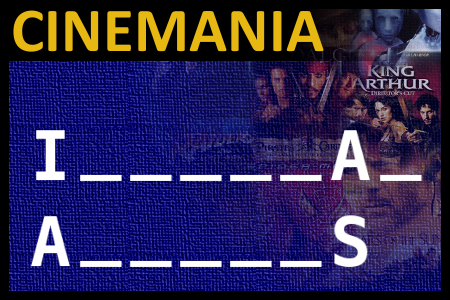
CINEMANIA: Guess the movie title
[721] CINEMANIA: Guess the movie title - Keen young Raymond Avila joins the Internal Affairs Department of the Los Angeles police. He and partner Amy Wallace are soon looking closely at the activities of cop Dennis Peck whose financial holdings start to suggest something shady. Indeed Peck is involved in any number of dubious or downright criminal activities. He is also devious, a womaniser, and a clever manipulator, and he starts to turn his attention on Avila. Film was made in 1990. - #brainteasers #movie #film #cinemania - Correct Answers: 53 - The first user who solved this task is Sanja Šabović
BRAIN TEASERS
enter your answer and press button OK

CINEMANIA: Guess the movie title

Keen young Raymond Avila joins the Internal Affairs Department of the Los Angeles police. He and partner Amy Wallace are soon looking closely at the activities of cop Dennis Peck whose financial holdings start to suggest something shady. Indeed Peck is involved in any number of dubious or downright criminal activities. He is also devious, a womaniser, and a clever manipulator, and he starts to turn his attention on Avila. Film was made in 1990.
Correct answers: 53
The first user who solved this task is Sanja Šabović.
#brainteasers #movie #film #cinemania
Register with your Google Account and start collecting points.
Check your ranking on list.

I Wish I Was Rich

A genie came to me and asked, "What's your first wish?"
I answered, "I wish I was rich!"
Then the genie said, "What's your second wish, Rich?"

Jokes of the day - Daily updated jokes. New jokes every day.
Follow Brain Teasers on social networks

Brain Teasers

puzzles, riddles, mathematical problems, mastermind, cinemania...

Kepler's Law

In 1618, Johannes Kepler discovered his harmonics law published in his five-volume work Harmonices Mundi (Harmony of the Worlds, 1619). He attempted to explain proportions and geometry in planetary motions by relating them to musical scales and intervals (an extension of what Pythagoras had described as the “harmony of the spheres”.) Kepler said each planet produces musical tones during its revolution about the sun, and the pitch of the tones varies with the angular velocities of those planets as measured from the sun. The Earth sings Mi, Fa, Mi. At very rare intervals all planets would sing in perfect concord. Kepler proposed that this may have happened only once in history, perhaps at the time of creation.«[Image: Title page from Kepler's Harmonices Mundi.]
This site uses cookies to store information on your computer. Some are essential to help the site properly. Others give us insight into how the site is used and help us to optimize the user experience. See our privacy policy.