CINEMANIA: Guess the movie title
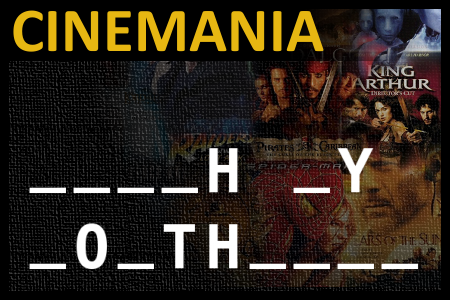
[922] CINEMANIA: Guess the movie title - A hapless New York advertising executive is mistaken for a government agent by a group of foreign spies, and is pursued across the country while he looks for a way to survive. Film was made in 1959. - #brainteasers #movie #film #cinemania - Correct Answers: 58 - The first user who solved this task is Djordje Timotijevic
BRAIN TEASERS
enter your answer and press button OK

CINEMANIA: Guess the movie title

A hapless New York advertising executive is mistaken for a government agent by a group of foreign spies, and is pursued across the country while he looks for a way to survive. Film was made in 1959.
Correct answers: 58
The first user who solved this task is Djordje Timotijevic.
#brainteasers #movie #film #cinemania
Register with your Google Account and start collecting points.
Check your ranking on list.

The boss ordered one of his me...

The boss ordered one of his men to dig a hole eight feet deep. After the job was completed the boss returned and explained an error had been made and the hole wouldn't be needed. "Fill 'er up," he ordered.
The worker did as he'd been told. But he ran into a problem. He couldn't get all the dirt packed back into the hole without leaving amound on top. He went to the office and explained his problem.
The boss snorted. "Honestly! The kind of help you get these days! There's obviously only one thing to do. You'll have to dig that hole deeper!"
Jokes of the day - Daily updated jokes. New jokes every day.
Follow Brain Teasers on social networks

Brain Teasers

puzzles, riddles, mathematical problems, mastermind, cinemania...

Sir D'Arcy Wentworth Thompson

Died 21 Jun 1948 at age 88 (born 2 May 1860).Scottish zoologist and classical scholar, who is noted for his influential workOn Growth and Form (1917, new ed. 1942). It is a profound consideration of the shapes of living things, starting from the simple premise that “everything is the way it is because it got that way.”Hence one must study not only finished forms, but also the forces that moulded them: “the form of an object is a ‘diagram of forces’, in this sense, at least, that from it we can judge of or deduce the forces that are acting or have acted upon it.”' One of his great themes is the tremendous light cast on living things by using mathematics to describe their shapes and fairly simple physics and chemistry to explain them..
This site uses cookies to store information on your computer. Some are essential to help the site properly. Others give us insight into how the site is used and help us to optimize the user experience. See our privacy policy.