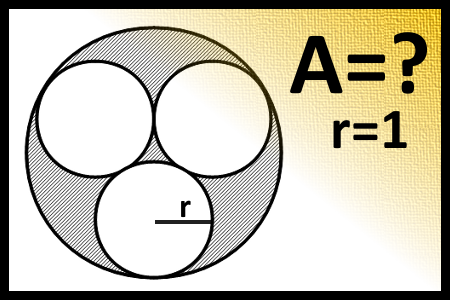
Find the area of the shaded figure
[224] Find the area of the shaded figure - Express result to the accuracy of 2 decimal. - #brainteasers #math - Correct Answers: 55 - The first user who solved this task is Djordje Timotijevic
BRAIN TEASERS
enter your answer and press button OK

Find the area of the shaded figure

Express result to the accuracy of 2 decimal.
Correct answers: 55
The first user who solved this task is Djordje Timotijevic.
#brainteasers #math
Register with your Google Account and start collecting points.
Check your ranking on list.

Ponderings Collection 21

Who is General failure and why is he reading my disk ?
The light went out, but where to ?
Why do banks charge you a "non-sufficient funds fee" on money they already know you don't have?
Why is it you have a "pair" of pants and only one bra?
How come when I call Information they can't tell me where my keys are?
Why do people go to Burger King and Order a Double Whopper with a Large French Fry and insist on getting a Diet Coke?
Does the reverse side also have a reverse side?
Why is the alphabet in that order?
If the universe is everything, and scientists say that the universe is expanding, what is it expanding into?
If you got into a taxi and he started driving backwards, would the taxi driver end up owing you money?
Jokes of the day - Daily updated jokes. New jokes every day.
Follow Brain Teasers on social networks

Brain Teasers

puzzles, riddles, mathematical problems, mastermind, cinemania...

William J. Hamilton

Born 11 Dec 1902; died 27 Jul 1990 at age 87.William John Hamilton, Jr. was an American mammalogist and environmentalist was an American mammalogist and environmentalist who stressed the vital ecological role of predators and the importance of conserving fur-bearing populations. His interest in plants and animals began in childhood, and working while a teenager for three summers for Daniel C. Beard (a naturalist, artist, and cofounder of the Boy Scouts of America). Hamilton's research dealt with mammals, birds, reptiles, amphibians, and horticulture, with a major interest was in life histories and ecology. He wrote books, including American Mammals (1939), and over 200 papers. He also made some pioneering studies of microtine life cycles.«
This site uses cookies to store information on your computer. Some are essential to help the site properly. Others give us insight into how the site is used and help us to optimize the user experience. See our privacy policy.