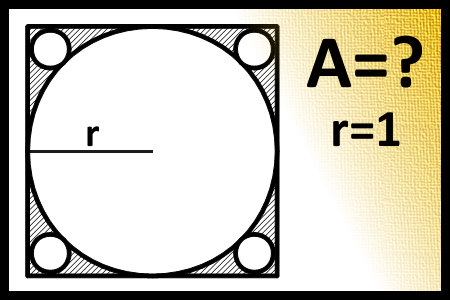
Find the area of the shaded figure
[258] Find the area of the shaded figure - Express result to the accuracy of 3 decimal. - #brainteasers #math - Correct Answers: 24 - The first user who solved this task is Sanja Šabović
BRAIN TEASERS
enter your answer and press button OK

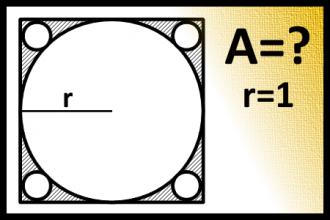
Find the area of the shaded figure

Express result to the accuracy of 3 decimal.
Correct answers: 24
The first user who solved this task is Sanja Šabović.
#brainteasers #math
Register with your Google Account and start collecting points.
Check your ranking on list.

Redneck Wants To Fight

There were some backwoods hillbillies living across the river from each other, who feuded constantly. John hated Clarence with a passion and never passed up a chance to throw rocks across the river at Clarence. This went on for years until one day the Corps of Engineers came to build a bridge across that river. John was elated; he told his wife that finally he was going to get the chance to cross over and whip Clarence.
He left the house and returned in a matter of minutes. His wife asked what was wrong, didn't he intend to go over the bridge and whip Clarence? He replied that he never had really seen Clarence up close and didn't realize his size until he started over the bridge and saw the sign: "CLEARANCE 8 FT 3 IN"
Jokes of the day - Daily updated jokes. New jokes every day.
Follow Brain Teasers on social networks

Brain Teasers

puzzles, riddles, mathematical problems, mastermind, cinemania...

Lloyd Viel Berkner

Born 1 Feb 1905; died 4 Jun 1967 at age 62.American physicist and engineer who first measured the extent, including height and density, of the ionosphere (ionized layers of the Earth's atmosphere), leading to a complete understanding of radio wave propagation and he helped develop radar systems, especially the Distant Early Warning system. He later investigated the origin and development of the Earth's atmosphere. Early in his career, he worked on radio navigation beacons for the Airways division of the Bureau of Lighthouses (1927-28), as radio engineer on the Byrd Antarctic expedition (1928-30). Returning to the U.S. Bureau of Standards (1930-33) he studied the ionosphere using radio-pulse transmissions, then terrestrial magnetism with the Carnegie Institution (1933-51).
This site uses cookies to store information on your computer. Some are essential to help the site properly. Others give us insight into how the site is used and help us to optimize the user experience. See our privacy policy.