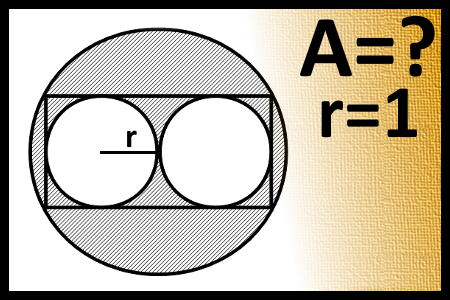
Find the area of the shaded figure
[306] Find the area of the shaded figure - Express result to the accuracy of 3 decimal. - #brainteasers #math - Correct Answers: 72 - The first user who solved this task is Djordje Timotijevic
BRAIN TEASERS
enter your answer and press button OK

Find the area of the shaded figure

Express result to the accuracy of 3 decimal.
Correct answers: 72
The first user who solved this task is Djordje Timotijevic.
#brainteasers #math
Register with your Google Account and start collecting points.
Check your ranking on list.

What a talent...

A family was visiting an Indian reservation when they happened upon an old tribesman lying face down in the middle of the road with his ear pressed firmly against the blacktop.

The father of the family asked the old tribeman what he was doing. The tribesman began to speak..."woman, late thirties, three kids, one barking dog in late model, white, four-door station wagon, traveling at 65 m.p.h.

"That's amazing!" exclaimed the father. "You can tell all that just by listening to the ground?"

"No," said the old tribesman, weakly. "They just ran over me five minutes ago!"

Jokes of the day - Daily updated jokes. New jokes every day.
Follow Brain Teasers on social networks

Brain Teasers

puzzles, riddles, mathematical problems, mastermind, cinemania...

Jan Evangelista Purkinje

Born 17 Dec 1787; died 28 Jul 1869 at age 81.Czech pioneer of experimental physiology whose investigations in the fields of histology, embryology and pharmacology helped to create a modern understanding of the eye and vision, brain and heart function, mammalian reproduction and the composition of cells. In 1837, Purkinje described not only clusters of beautiful drop-like cells, but also subtle elongated fiber-like processes in their vicinity, which seemed to be peculiar to the nervous system. Purkinje was the first to use the microtome, potassium bichromate and Canada balsam in the preparation of histological slides for microscopy. Purkinje introduced the scientific terms plasma, a component of blood, and protoplasm, used to describe young animal embryos.
This site uses cookies to store information on your computer. Some are essential to help the site properly. Others give us insight into how the site is used and help us to optimize the user experience. See our privacy policy.