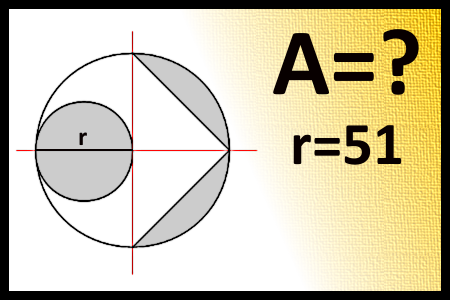
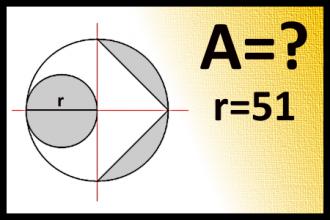
Find the area of the shaded figure
[376] Find the area of the shaded figure - Express result to the accuracy of 3 decimal. - #brainteasers #math - Correct Answers: 51 - The first user who solved this task is Djordje Timotijevic
BRAIN TEASERS
enter your answer and press button OK

Find the area of the shaded figure

Express result to the accuracy of 3 decimal.
Correct answers: 51
The first user who solved this task is Djordje Timotijevic.
#brainteasers #math
Register with your Google Account and start collecting points.
Check your ranking on list.

Private Audience With the Holy Mother

After a long life of unselfish service, Father John O'Malley died and went to heaven. St. Peter met him at the gate and said: "John, you did such a wonderful job for us on earth, we'd like to do something special for you. You name it; it's yours."
John thought for a moment and said: "I'd like a private audience with the Holy Mother." St. Peter told him it would be arranged.On the appointed day, St. Peter escorted John to the Holy Mother's sanctuary. John went before Her, knelt, and said: "Holy Mother, I've always looked to You for guidance, and You have granted me peace and serenity through some difficult times. But I have one question that has nagged me during my whole time on earth. In all the paintings that were done of you, and in all the sculptures that were carved of you, you always looked so sad. Why is that?"
Mary thought for a moment, pursing her lips. She said: "I always wanted a girl."

Jokes of the day - Daily updated jokes. New jokes every day.
Follow Brain Teasers on social networks

Brain Teasers

puzzles, riddles, mathematical problems, mastermind, cinemania...

Charles Gerhardt

Born 21 Aug 1816; died 19 Aug 1856 at age 39. Charles (-Frédéric) Gerhardt was a French chemist who, with Auguste Laurent, developed a classification of organic compounds. Like most chemists he was aware that the dualistic system of Jöns Berzelius was unsatisfactory and tried to create an alternative. He adopted what became known as type theory in which he thought all organic compounds were based on four main types - hydrogen, hydrogen chloride, ammonia, and water. Organic compounds were referred to these types by replacing a hydrogen atom in one of these compounds by a radical (i.e., by a group of atoms). His idea was opposed by his contemporaries and was later abandoned, but it proved important in the subsequent rationalization of structural organic chemistry.
This site uses cookies to store information on your computer. Some are essential to help the site properly. Others give us insight into how the site is used and help us to optimize the user experience. See our privacy policy.