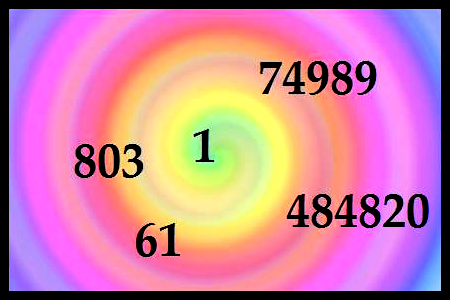
Find a missing number
[876] Find a missing number - Author: Lidija Duvnjak - #brainteasers #math - Correct Answers: 30 - The first user who solved this task is Slobodan Strelac
BRAIN TEASERS
enter your answer and press button OK

Find a missing number

Author: Lidija Duvnjak
Correct answers: 30
The first user who solved this task is Slobodan Strelac.
#brainteasers #math
Register with your Google Account and start collecting points.
Check your ranking on list.

There were these twin sisters...

There were these twin sisters just turning one hundred years old in St. Luke's Nursing Home and the editor of the Cambridge rag, "The Cambridge Distorter," told a photographer to get over thereand take the pictures of these 100 year old twin bitteys.
One of the twins was hard of hearing and the other could hear quite well.
The photographer asked them to sit on the sofa and the deaf one said to her twin, "WHAT DID HE SAY?"
He said, "WE GOTTA SIT OVER THERE ON THE SOFA!" said the other.
"Now get a little closer together," said the cameraman.
Again, "WHAT DID HE SAY?"
"HE SAYS SQUEEZE TOGETHER A LITTLE." So they wiggled up close to each other.
"Just hold on for a bit longer, I've got to focus a little," said the photographer.
Yet again, "WHAT DID HE SAY?"
"HE SAYS HE'S GONNA FOCUS!"
With a big grin the deaf twin shouted out, "OH MY GOD - BOTH OF US?"
Jokes of the day - Daily updated jokes. New jokes every day.
Follow Brain Teasers on social networks

Brain Teasers

puzzles, riddles, mathematical problems, mastermind, cinemania...

Max Planck

Born 23 Apr 1858; died 4 Oct 1947 at age 89. Max Karl Ernst Ludwig Planck was a German theoretical physicist who studied at Munich and Berlin, where he studied under Helmholtz, Clausius and Kirchhoff and subsequently joined the faculty. He became professor of theoretical physics (1889-1926). His work on the law of thermodynamics and the distribution of radiation from a black body led him to abandon classical Newtonian principles and introduce the quantum theory (1900), for which he was awarded the Nobel Prize for Physics in 1918. This assumes that energy is not infinitely subdivisible, but ultimately exists as discrete amounts he called quanta (Latin, “how much”). Further, the energy carried by a quantum depends in direct proportion to the frequency of its source radiation.
This site uses cookies to store information on your computer. Some are essential to help the site properly. Others give us insight into how the site is used and help us to optimize the user experience. See our privacy policy.